intelligence Crypto Monthly Review — September 2026: Authorization by Infrastructure CLARITY died in the Senate 49 to 50, and the rails shipped anyway: a 21-bank dollar stablecoin, tokenized deposits live, the CFTC writing by guidance what Congress would not pass. September 2026, in one monthly piece.
intelligence Crypto Trends Week 35 2026: Tokenize Everything, Own the Rail — The Week Wall Street and the Banks Came Onchain on Infrastructure They Control Coinbase tokenized stocks went live on Base, Bullish's onchain cap table drew fresh attention, 39 banking associations formed BankChain, and bitcoin ran near $81,000 before Warsh cooled it. The week Wall Street and the banks came onchain, on rails they own.
intelligence The Optional Filter: Arbitrum's Elara Puts a Compliance Switch in the Chain Owner's Hand With ArbOS 61 "Elara" (live 20 August 2026), Arbitrum shipped optional compliance filtering for its dedicated chains — off by default, not on One or Nova. But where it runs, the screening switch belongs to the chain owner, not ArbitrumDAO, and the user can't opt out.
intelligence Can the CFTC Just Write the Rules Itself? The CFTC chair said the agency will start building crypto market rules under existing powers if Congress does not pass a law. Nothing has been filed. One question decides the rest: can a regulator write the rules for a market on its own, or does that take an act of Congress?
editorial They Announced the Rules. They Wrote Nothing. The man who runs the CFTC said he will build the rules for crypto himself if Congress will not. Nothing was filed. Two sentences, and a token worth billions moved on them. Alex Cache on the men collecting the dividends of rules that do not exist, and who funds them.
intelligence Crypto Trends Week 34 2026: The Referee Picks Up a Bat. The State Wrote the Rulebook, Moved the Market, and Floated Buying the Asset The SEC proposed its first formal crypto rulemaking, the Treasury doubled bond buybacks and ripped Bitcoin to $77,000, and the president floated a US crypto reserve and the onshoring of Hyperliquid. The week the state stopped refereeing the market and started playing in it.
intelligence Who Decides What Counts as a Market You think a prediction market is a market. Whether it counts as one is a decision four parties are fighting over: the exchange self-certifies, the CFTC can veto, the states call it gambling, and the courts just split on the word "swap." Emma Rowe maps who actually holds the pen.
intelligence Crypto Trends Week 33 2026: The General Rule Stalls While the Named Exception Ships The SEC canceled its "Regulation Crypto" rulemaking and delayed the tokenization exemption, while the OCC cleared the Trump-linked World Liberty charter and the CFTC shielded Kalshi. This is the week "regulated" stopped meaning rule-bound and started meaning permissioned case by case.
Ecosystem Open USD: The Consortium Stablecoin That Shares the Float Open USD is a dollar stablecoin backed by 140+ partners — Visa, Mastercard, BlackRock, Stripe, Coinbase — that hands reserve yield to distributors, not one issuer. Circle's stock fell on the news. But as of August 2026 it isn't live, and control still sits with the operator.
Ecosystem Polymarket: Prediction-Market Infrastructure & Control Points The largest prediction market, decoded as infrastructure: ~$9B monthly volume, a geoblocked International venue and a CFTC-licensed US venue via QCEX, ICE (NYSE's parent) in for up to $2B, and a UMA token-vote oracle that settles disputed truth. No house on the trade — a house on the truth.
intelligence Crypto Trends Week 32 2026: The Coldcard Drain Becomes a Referendum on Self-Custody as the Money Flees to the Regulated Rail A five-year-old Coldcard flaw detonated into the worst self-custody breach on record, over $130M drained by 15 attackers using AI to reconstruct keys. As 210,000 BTC left old wallets, spot Bitcoin ETFs saw their best week since April. When the sovereign stack failed, capital fled to the rail.
intelligence Crypto Trends Week 31 2026: The CME Sues the CFTC Over Onchain Perpetual Futures as Everything Becomes a Perp The CME sued the CFTC to block onchain perpetual futures as everything becomes a perp and price discovery moves to the instrument. Circle stacked nearly 1,000 IBM patents and a New York trust charter, and a Coldcard firmware flaw drained roughly $88M from 4,585 self-custody wallets.
intelligence Crypto Trends Week 30 2026: Uniswap Ships Permissioned Pools and Ondo's Broker-Dealer Wins SEC Clearance to Sell Tokenized Stocks On July 22 Uniswap shipped Permissioned Pools, enforcing issuer allowlists onchain. Ondo's broker-dealer was cleared by the SEC and FINRA to sell tokenized stocks to US investors, and real-world assets out-traded crypto on Hyperliquid. Week 30 is when the gate moved into the protocol.
editorial We Built the Rails and Handed Them Over Two weeks ago I wrote that disintermediation was an illusion. This week it became architecture. The DTCC ran live tokenized trades with Wall Street on both sides, and Visa chose the banks' coin over Circle's, days after Circle's charter. The charter was never the moat. Distribution is.
intelligence Crypto Trends Week 29 2026: DTCC Processes the First Live Tokenized Trades With BlackRock, JPMorgan and the NYSE as Visa Launches a Stablecoin Platform On July 15 the DTCC, which settles nearly every US stock trade, ran its first live tokenized trades with BlackRock, JPMorgan, Goldman and the NYSE. Visa launched a stablecoin platform on Open USD, Stripe bid $53B for PayPal, and Japan reclassified crypto as a financial instrument. Week 29 read.
intelligence Crypto Trends Week 28 2026: Circle Wins a National Bank Charter as Coinbase, Ripple, Kraken and Sony Bank All Move on Licenses in the Same Week Seven days after Visa, Mastercard, Stripe and Coinbase launched Open USD against it, Circle won an OCC national trust charter. Not a better product. A federal license. Coinbase, Ripple, Kraken and Sony Bank moved on licenses the same week, while the permissionless layer lost $1.31B in six months.
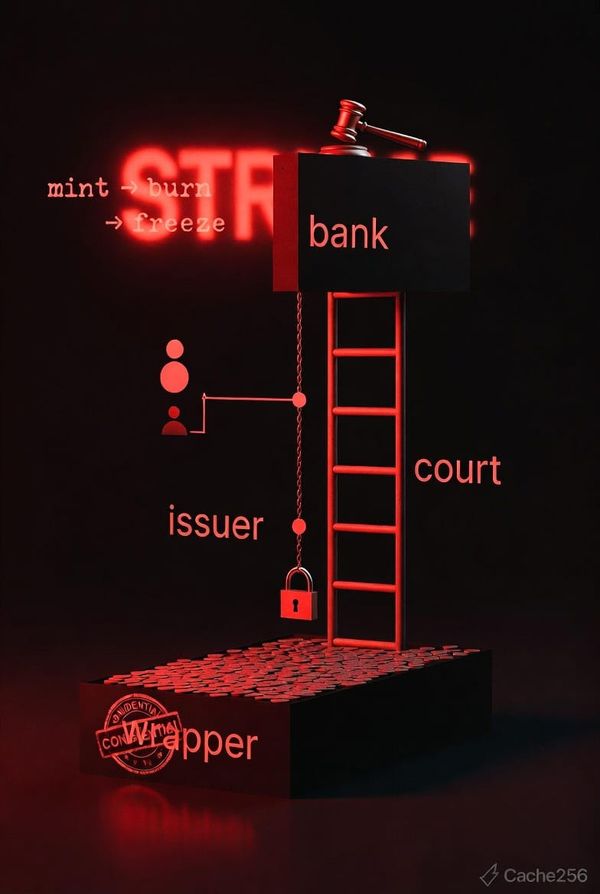
intelligence The Bearer Illusion — Why On-Chain Dollars Were Always Issuer-Controlled In May 2026 a court made Circle freeze a whole confidential USDC pool to reach one deposit. The privacy wrapper changed nothing — the dollar on-chain was never bearer. Six days later the banks announced the rail that replaces the issuer entirely. STRIKE//ΔCT on the chokepoint that climbs.
intelligence Crypto Trends Week 27: Institutions Are Named Bitcoin's Buyer as Strategy Turns Seller, the Ethereum Foundation Split Formalizes & 140 Firms Launch Open USD Week 26 cracked two pillars. Week 27 is the changing of the guard: Strategy is authorized to sell $1.25B in bitcoin as institutions are named its successor buyer, the Ethereum Foundation split formalizes into new steward entities, and 140 firms launch Open USD against the Circle-Tether duopoly.
intelligence Crypto Trends Week 26: The Ethereum Foundation Cuts 20% of Staff, Strategy's STRC Melts Down & Bitcoin Breaks Its Decade-Long Q2 Pattern Week 25 met the rate wall and the rail war. Week 26 is where two institutional pillars crack: the Ethereum Foundation cuts 20% of its staff and Strategy's STRC preferred melts down to a record discount, as bitcoin breaks below $60K and its decade-long Q2 pattern. The floor gave way.
editorial Prediction Markets: Who Decides What You Can Bet On? Rosetta's debut, the neutral voice of Cache256 Decode. In June 2026 the CFTC took an 8th state to court over prediction markets and opened a consultation (to 27 July), as Polymarket reached 200M users. Financial product or gambling? A clear map of who decides what you can bet on.
Ecosystem Stellar: The Cross-Border Rail Institutions Use; and the Token That Doesn't Capture It Stellar quietly became production infrastructure for regulated payments and tokenized RWAs — Franklin BENJI ($654M), native Circle USDC + CCTP, MoneyGram corridors — on an elegant non-PoS consensus. Two honest gaps: XLM decoupled from network usage, and a 7-org tier-1 quorum racing to 13.
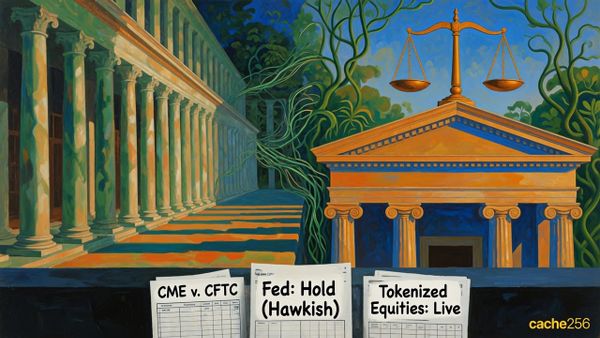
intelligence Hold, CME Sues the CFTC Over Onshore Perps & Tokenized Equities Ship at Scale Week 24 was the rebound. Week 25 is where it meets two walls: a hawkish Fed under the new Chair caps the rally, and CME sues the CFTC over the onshore-perp approval. Tokenized equities ship across Coinbase, Kraken and Ondo, and Coinbase becomes an everything-app. The rail war reaches the courts.
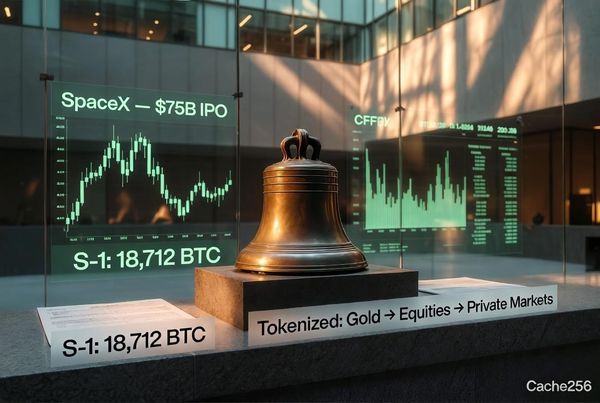
intelligence Crypto Trends Week 24: SpaceX Closes a Record $75B IPO Holding 18,712 BTC, Trump Cancels the Iran Strikes & Wall Street Ships Tokenization Week 23 was the cyclical bill. Week 24 is the rebound: SpaceX closes a record $75B Nasdaq IPO carrying 18,712 BTC, Trump cancels the Iran strikes, Saylor buys the dip back, and Wall Street ships tokenization as live product. The treasury bid sorted, it didn't break.
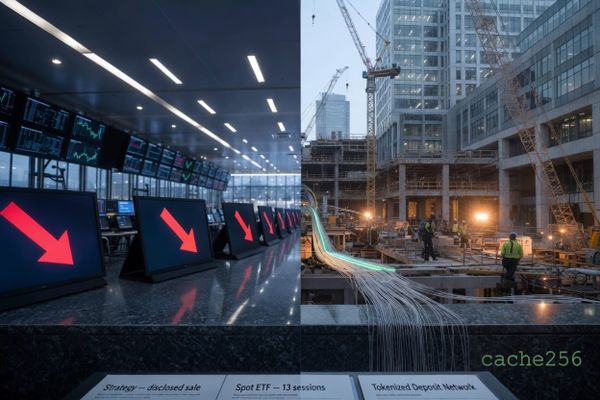
intelligence Crypto Trends Week 23: Strategy Sells Bitcoin, Record 13-Session ETF Outflow Streak & an AI Finds a Critical Zcash Bug Week 22 shipped the operating manual. Week 23 is the price — Strategy's first bitcoin sale in years, a record 13-session ETF outflow streak, an AI-found Zcash bug, and the banks building their own tokenized-deposit rail. The Great Unwind the permission structure couldn't suspend.
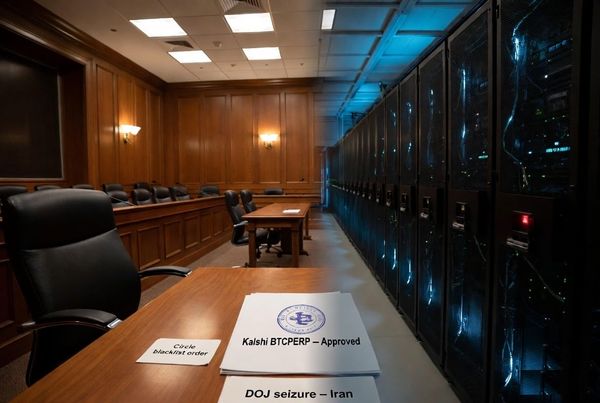
intelligence Crypto Trends Week 22: CFTC Greenlights Onshore BTC Perps, $1B Iran Crypto Seizure & Circle-Zama cUSDC Blackout Week 21 was the convergence the Warsh silence permitted. Week 22 is the operating manual that ships the next day — CFTC clears Kalshi BTCPERP and Coinbase global routing, US seizes $1B Iran crypto, a federal court forces Circle to blacklist Zama cUSDC, and the privacy stack ships in parallel.