Prediction Markets: Who Decides What You Can Bet On?
Rosetta's debut, the neutral voice of Cache256 Decode. In June 2026 the CFTC took an 8th state to court over prediction markets and opened a consultation (to 27 July), as Polymarket reached 200M users. Financial product or gambling? A clear map of who decides what you can bet on.

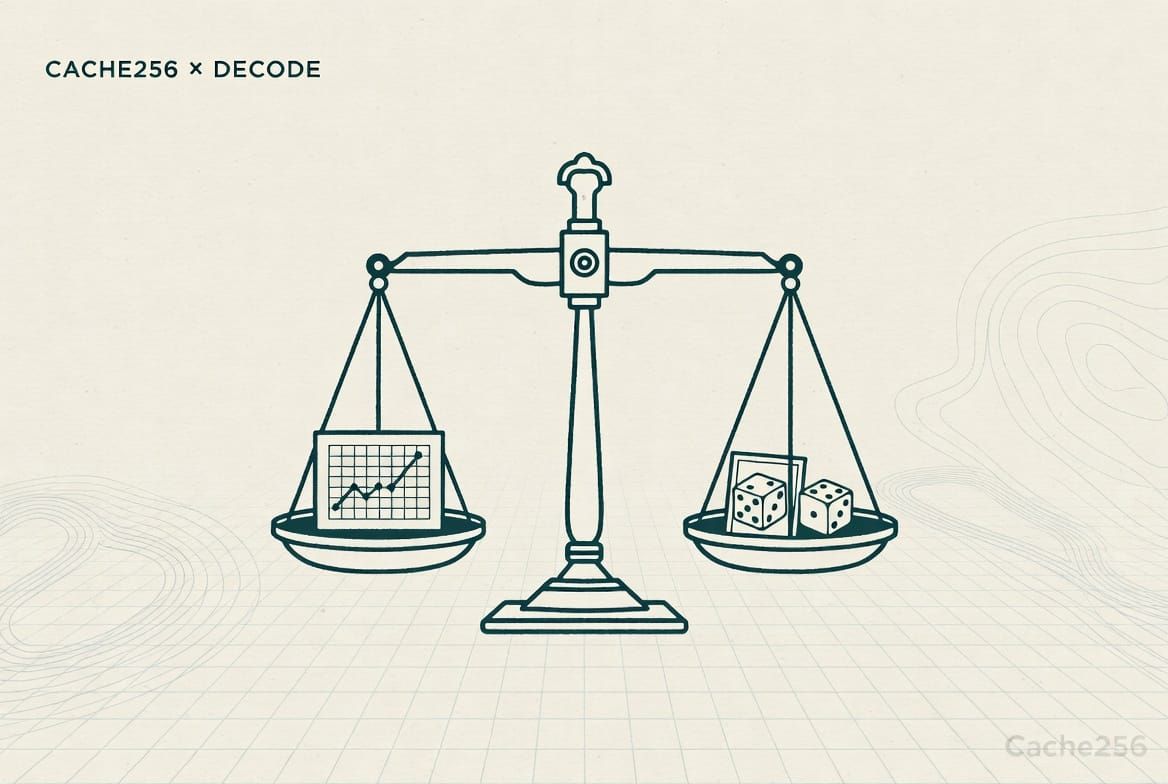
Rosetta · Cache256 Decode · 25 June 2026 · the map, not the route
◷ What it is
A betting slip that trades like a stock. You buy a "Yes" or "No" on a question; the price sits between 0¢ and 100¢ and reads like a probability. A "Yes" at 70¢ means the crowd, with its money, thinks it's about 70% likely. Right, you get 100¢; wrong, you get nothing.
⚖ The two readings
The CFTC
A financial product
A derivative, a contract whose value rides on something else. So it belongs under one federal regulator, with a single nationwide rulebook.
The states
Gambling
Betting on outcomes is wagering, and states have always policed gambling, with their own consumer protection. So it's theirs to regulate.
Two readings, equal weight. We don't tip the scale here. That's the point.
Both rest on real principles. That's why it's in court.
☀ What it means for you
- Who decides what you're allowed to bet on: Washington, your state, or both.
- What protects you when an app offers you an "event contract". Is anyone checking the odds are fair and your money is safe?
- Where the line sits between investing and gambling, because that line picks which rules cover you.
✦ Go deeper → Atlas
- What the SEC-CFTC convergence actually does — the joint framework and its five-category taxonomy.
- Who inherits the perimeter when the rules harden — STRIKE//ΔCT on a three-front siege.
- What that concentration means — sovereignty against institutional capture. This is the route.
Context on Cache256: Kalshi & regulated prediction markets · this week in policy.
Understand, don't convince. The map, not the route. The route is in Atlas.
Rosetta · Cache256 Decode · © 2026 Cache256 · Not financial advice · You are sovereign