Crypto Trends Week 21: TradFi Pipes Wired Into Crypto Venues, SEC IPO Rewrite & Trump Digital-Asset Executive Order
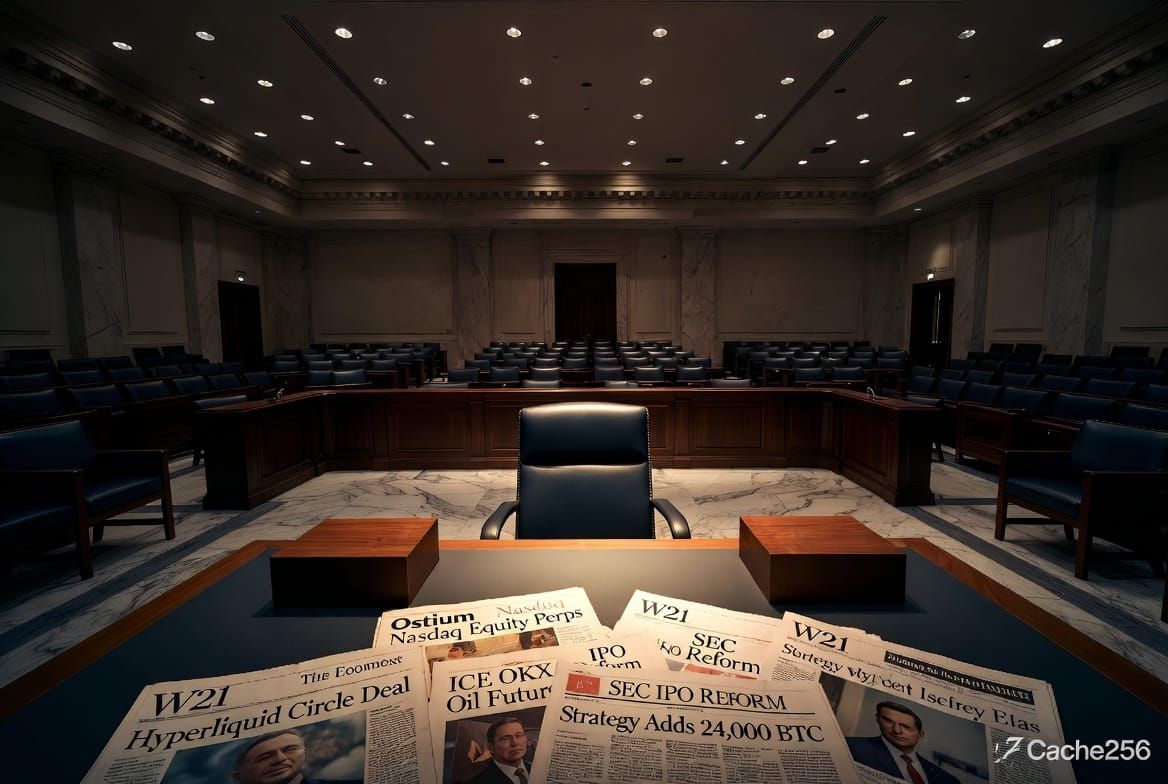
The first two weeks of the Warsh Fed chair were supposed to be quiet. Seven structural TradFi×crypto deals stacked instead — Hyperliquid×Circle, Ostium×Nasdaq, ICE×OKX, the SEC IPO rewrite, the Trump EO. Week 21 is the convergence the Warsh silence permitted.
|=|=|=|=|=|=|=|=|=|=|=|=|=|=|=|=|=|=|=|
CACHE256 | WEEKLY TRENDS
|=|=|=|=|=|=|=|=|=|=|=|=|=|=|=|=|=|=|=|
WEEK 21 · May 18 – May 24, 2026
// Strategic Feed // Signal Drop
The same Monday, the SEC files its proposed overhaul of IPO and public-company rules — the largest rewrite in roughly two decades, explicitly framed by Chair Atkins as lowering disclosure burdens for blockchain-native filers. Tuesday May 19, President Trump signs the executive order Integrating Financial Technology Innovation into Regulatory Frameworks, directing SEC, CFTC, OCC, Treasury and the Fed to update digital-asset frameworks, expand master-account access, and streamline rules. The Fed appears in the EO's distribution list but the framework-setting work is delegated outward. Warsh's silence is structurally compensated. The convergence is not regulator-led — it is infrastructure-led, with regulators publishing rulemaking in parallel rather than gating it.
In the background, three security incidents punctuate the week — Echo Protocol drained for $77M on Monad (May 19, eBTC admin-key compromise), Verus-Ethereum bridge drained for ~$11M (May 18), Polymarket's six-year-old admin wallet compromised for ~$700K (May 22). Aggregate $89M in five days. The institutional flows do not flinch — Strategy adds ~24,000 BTC for $2B Monday (taking total holdings near 844,000 BTC), and SpaceX's S-1 disclosure Wednesday confirms 18,712 BTC on its balance sheet at March 31. The structural read of Week 21: silence is not absence. It is a permission structure. The Warsh window is being used.
• Ostium × Nasdaq Equity Perpetuals (May 19): First on-chain venue offering perpetual futures on individual US equities, powered by official Nasdaq reference data feeds. TradFi-grade data inside a decentralized derivatives protocol. Operational implication: the oracle market expands from "crypto-native oracle vs crypto-native oracle" to include direct TradFi exchange feeds.
• ICE × OKX Perpetual Oil Futures (May 22): Intercontinental Exchange and OKX co-launch perpetual (never-expiring) Brent/WTI contracts using ICE benchmarks on OKX. ICE holds an equity stake in OKX. Pattern signal: tier-1 traditional exchange operators are partnering with crypto-native venues for distribution rather than building defensive crypto front-ends.
• SEC IPO Rule Overhaul Proposed (May 19): Largest proposed overhaul of US public-company rules in approximately two decades. Eases disclosure and audit burdens, raises large-accelerated-filer thresholds, and is explicitly noted as beneficial for blockchain-native companies seeking public listings. Chair Atkins frames the proposal as a deliberate move from enforcement-dominant to rulemaking-dominant SEC posture.
• Trump Executive Order — Digital-Asset Framework Integration (May 19): EO Integrating Financial Technology Innovation into Regulatory Frameworks directs SEC, CFTC, OCC, Treasury and other federal regulators to update digital-asset frameworks, streamline rules, and expand access (including Fed master accounts). The Fed appears in the distribution list but the framework-setting work is delegated outward — institutionally consistent with the recusal architecture.
• Strategy Adds ~24,000 BTC for $2B (May 18): ~24,000–24,869 BTC purchased at average ~$80,985–$83K/BTC, bringing total holdings near 844,000 BTC. Largest single-week corporate BTC accumulation since late 2024. Pricing implies aggressive buying into the W21 weakness rather than trend-following accumulation.
• SpaceX S-1 Discloses 18,712 BTC on Balance Sheet (May 20): Confidential S-1 made public around May 20–21 confirms SpaceX held 18,712 BTC as of March 31, 2026 (fair value ~$1.29B at that date). First top-tier private corporate disclosure of a BTC treasury position inside an active IPO filing. Sets a precedent for treasury BTC disclosure as standard line item in pre-IPO documentation.
• DeFi Security Cadence — Echo $77M + Verus $11M + Polymarket $700K: Echo Protocol exploited for ~$77M via unauthorized eBTC minting on Monad (admin-key compromise, May 19). Verus-Ethereum bridge drained for ~$11M+ in ETH, tBTC, USDC (May 18). Polymarket's six-year-old admin/rewards wallet compromised for ~$700K POL + USDC (May 22, user funds unaffected, confirmed by on-chain investigators). Aggregate ~$89M visible loss in five days.
• Minnesota Bans Prediction Markets — Felony Status (May 19): First US state to criminalize operation and advertising of prediction markets (Polymarket, Kalshi, etc.). Immediate CFTC/Trump-administration federal lawsuit follows. State-federal preemption fight opens; outcome will set precedent affecting state-level crypto regulation broadly, including the Minnesota crypto custody bill signed the same week.
• Catena Labs $30M Series A — AI-Agent Banking Infrastructure (May 20): Sean Neville (Circle co-founder) raises $30M led by a16z crypto + Acrew Capital to build regulated banking infrastructure for AI agents. National trust bank charter filing with OCC. First substantively-funded attempt to charter AI agents as economic actors with banking access.
• BoE / FCA Tokenization Consultation Opens (May 18): Bank of England and FCA seek public feedback on tokenization's role in UK financial markets. Signals UK-EU divergence path on tokenization rules — separate timing and scope from EU MiCA. Cross-border institutional allocators with UK exposure will need a second compliance track within 2–3 quarters.
• China Dual-Track Digital Currency Strategy Re-Surfaces (May 19): CoinDesk reporting confirms the operational pattern — centralized CBDC for domestic surveillance and economic control, paired with significant strategic Bitcoin reserves as external geopolitical instrument. Former CFTC chair Christopher Giancarlo's May 20 remark that a US CBDC is "inevitable" given global market dynamics validates the trajectory without committing to a US implementation timeline.
• Senator Warren Demands OCC Crypto Bank Charter Explanation (May 19): Formal inquiry pressures OCC's chartering posture for crypto firms. Signals durable Democratic opposition that will constrain future OCC chartering under Republican administrative push. Catena Labs trust bank charter application enters this contested perimeter.
• Venue-Side Stablecoin Revenue Extraction: The Hyperliquid × Coinbase × Circle Aligned Quote Asset v2 deal is the structural turn of the week. For five years, stablecoin reserve yield economics flowed from issuer to issuer treasury, with only the largest distributors (Coinbase via the Centre legacy) extracting meaningful rebates. The Hyperliquid arrangement extends rebate-style economics — up to ~90% of generated reserve yield — to a perp DEX. The implication is not Hyperliquid-specific. It is precedent-specific. Any sufficiently large venue holding USDC float can now negotiate the same terms. The unit economics of crypto trading venues just improved structurally, and the float-providing layer (Circle in this instance, Tether by analogy in a future negotiation) absorbs the cost.
• TradFi Reference Data Inside Decentralized Protocols: Ostium × Nasdaq and ICE × OKX in the same week are the same signal expressed at two product layers. Equities perpetuals using Nasdaq reference data; oil perpetuals using ICE benchmarks. Two tier-1 traditional exchanges chose crypto-native venues as their distribution partners rather than building defensive crypto wrappers in-house. The oracle market — for the last cycle dominated by Chainlink, Pyth, RedStone and a handful of native crypto oracle providers — now has TradFi exchange data feeds as a competitive option. The "where does the price data come from and who certifies it" question has a new answer in May 2026.
• SEC Posture Shift From Enforcement to Rulemaking: The IPO rule overhaul proposal is the SEC's largest rewrite in ~20 years, explicitly framed by Chair Atkins to lower barriers for blockchain-native filers. The mechanism is the same one Cache256 named in W18: when a regulatory body moves from enforcement-as-primary-tool to rulemaking-as-primary-tool, institutional capital re-rates the risk premium attached to the asset class. The overhaul is in proposal form, but its directional signal is already absorbed — expect a queue of crypto IPO filings within 60–90 days, conditional on comment period without material amendment.
• Executive Order Delegates Outward, Fed Stays Silent: The Trump EO of May 19 directs SEC, CFTC, OCC, Treasury and other federal regulators to update digital-asset frameworks. The Fed appears in the EO distribution list but the framework-setting work is delegated to other agencies. This is institutionally consistent with Warsh's recusal architecture and confirms the W20 Cache256 framework: a hawkish-rule-bound Fed deferring substantive digital-asset enforcement to Treasury, OFAC and the SEC by structural design. The Fed's silence is not absence — it is structural compensation operating inside an executive-delegated framework.
• DeFi Exploit Cadence Becomes Operational Background: Three incidents in five days totaling ~$89M visible loss. Echo Protocol ($77M, eBTC admin-key compromise on Monad), Verus-Ethereum bridge (~$11M+), Polymarket admin wallet (~$700K from a six-year-old key). After Kelp DAO's $292M in W17, the cadence has moved from quarterly nine-figure events toward weekly seven-to-eight-figure events. The exploits no longer concentrate at one structural layer (verifier, custody, governance) — they distribute across admin-key management, bridge security, and protocol smart-contract logic. The substrate problem named in the W17–W20 arc is not retreating. It is being amortized into operational background noise that institutional allocators are visibly choosing not to reprice.
• Corporate BTC Treasury Becomes Standard IPO Line Item: Strategy's ~24,000 BTC purchase Monday and SpaceX's 18,712 BTC S-1 disclosure Wednesday operate on different surfaces — public-company accumulation versus pre-IPO treasury composition — but their combined effect is to normalize Bitcoin as a balance-sheet asset documented in regulatory filings. SpaceX's disclosure inside an active S-1 sets a precedent that pre-IPO companies with material BTC positions must now treat that position as a disclosable line item rather than a footnote. Treasury BTC is being absorbed into standard corporate-financial vocabulary.
2) INTERPRETATION
Week 21 reverses the orthodox reading of the post-Warsh transition. The institutional consensus expected infrastructure to wait while the new chair settled and the regulatory direction stabilized. The observed pattern is the opposite — seven structural deals stack inside the silence window, the SEC files its largest IPO rewrite in twenty years on the same day Trump signs the digital-asset EO, and the institutional capital allocators (Strategy +24,000 BTC, SpaceX 18,712 BTC disclosed) read the distributed action as a coordinated permission structure. The dominant split is institutional-versus-retail in form, but the substantive split is regulator-led-versus-infrastructure-led. The W21 data confirms the convergence has been infrastructure-led: TradFi exchanges (Nasdaq, ICE) approach crypto venues for partnerships rather than the inverse; venues (Hyperliquid) negotiate revenue extraction against issuers (Circle) rather than accept legacy terms; pre-IPO treasuries (SpaceX) document BTC positions as standard rather than novel. The Fed silence is structurally compensated by executive delegation. The substrate exploits ($89M across three events) do not flinch the flows. The Warsh window is being used.
3) MECHANISMS
• Hyperliquid × Coinbase × Circle Aligned Quote Asset v2 (May 18) → up to ~90% USDC reserve yield routed to venue → unit economics of perp DEX operations improves structurally → precedent extends rebate-style stablecoin economics to any sufficiently-large trading venue → float-providing layer absorbs cost asymmetrically.
• Ostium × Nasdaq + ICE × OKX (May 19 / May 22) → tier-1 TradFi exchange reference data inside decentralized perp protocols → oracle market expanded from crypto-native-only to include direct TradFi exchange feeds → competitive option for any protocol consuming equity or commodity reference data → partnership topology confirms TradFi distribution-via-crypto, not crypto-wrapped-by-TradFi.
• SEC IPO rule overhaul proposal (May 19) → largest rewrite in ~20 years → barriers lowered for blockchain-native filers → SEC posture confirmed shifting from enforcement-primary to rulemaking-primary → expect crypto IPO filing queue 60–90 days post comment period if survived without material amendment.
• Trump EO digital-asset framework (May 19) → directs SEC, CFTC, OCC, Treasury, Fed to update frameworks → framework-setting delegated outward; Fed in distribution list but not as primary → executive-delegated cadre consistent with Warsh recusal architecture → W20 hawkish-rule-bound-with-deference framework validated structurally.
• Echo Protocol $77M + Verus $11M + Polymarket $700K (May 18–22) → cadence moves quarterly-nine-figure to weekly-seven-to-eight-figure → exploits distribute across admin keys, bridges, protocol logic (no single structural concentration) → institutional allocators visibly choose not to reprice → substrate problem amortized into operational background.
• Strategy +24,000 BTC + SpaceX 18,712 BTC S-1 (May 18 / May 20) → public-company aggressive accumulation in single week → pre-IPO treasury BTC disclosed as standard S-1 line item → corporate BTC normalized into standard financial-document vocabulary → treasury Bitcoin held by tier-1 private operators (SpaceX) now documented in regulatory filings.
DECISION LENS (Bounded Choices)
The bounded choice that W21 surfaces is positioning across a regulatory permission structure being installed in real time. Operators reading the Warsh silence as a pause have the wrong frame — the silence is the cover under which the executive, the SEC, the OCC, and the state-level actors are publishing the rules that will govern the next four-quarter cycle. Allocators positioning for "regulatory clarity before deployment" are positioning for an event that already happened. The clarity is the EO. The clarity is the IPO rewrite. The clarity is Hyperliquid's revenue extraction. The convergence is not a future state — it is the May 18–24 datapoint. The institutional choice now is not whether to participate in the converged stack but on which side of the stack to hold: float-providing infrastructure (Circle as the cautionary case this week), venue-side extraction (Hyperliquid as the beneficiary), regulated bridges between TradFi data and crypto execution (Ostium / OKX), or pre-IPO treasury positioning (SpaceX as the precedent). The permission structure is not being announced. It is already being used.
4) IMPLICATIONS
Near-term: SEC IPO rule overhaul enters comment period — watch for crypto firm S-1 filings within 60–90 days. Trump EO directs federal regulator framework updates with implementation timelines likely visible Q3. First Minnesota prediction-market test case enters federal court — outcome will set state-federal preemption precedent.
Medium-term: Stablecoin revenue redistribution deals expected to replicate (at least two additional venue-side arrangements by Q4 2026). Q3 Fed framework operationalization under Warsh, post-confirmation public posture begins around early June. UK-EU tokenization rule divergence opens cross-border compliance question for institutional allocators with both-side exposure. OCC trust bank charter for Catena Labs (AI-agent banking infrastructure) is the visible early test of the chartering perimeter under partisan opposition.
Risks + Opportunities: Risk — admin-key management exploits (Echo Protocol pattern) extend to mid-cap DeFi protocols within 90 days, producing a second substrate stress cycle. Risk — Minnesota prediction-market federal lawsuit produces precedent constraining cross-state crypto operations broadly. Opportunity — venue-side stablecoin revenue extraction extends to perp DEXs other than Hyperliquid, repricing the trading-venue equity stack. Opportunity — pre-IPO BTC treasury disclosure becomes a default S-1 line item for the next wave of crypto-adjacent IPO candidates, normalizing institutional BTC as documented corporate asset.
5) COUNTER-SIGNALS
• The W21 Deals Are A Coincidence Of Timing, Not A Structural Convergence: Counter-narrative — Hyperliquid, Ostium, ICE×OKX and the SEC IPO rewrite are independent moves that happened to cluster inside the Warsh silence window by chance. Counter-counter: the deals' partnership topology (TradFi-distributing-via-crypto rather than crypto-wrapped-by-TradFi) is consistent across all four announcements; the SEC's deliberate framing of the IPO rewrite as blockchain-friendly comes from the same Chair (Atkins) who ended SEC enforcement-by-litigation in W18; the executive order distributes framework-setting away from the Fed precisely because the Fed's recusal architecture requires it. The cluster is structural, not coincidental.
• DeFi Decentralized Infrastructure Resists Capture By Definition: Counter-narrative — the W21 deals all touch the regulated perimeter (Hyperliquid is a venue, Ostium and OKX are regulated derivatives, the SEC and EO target public companies). Underlying DeFi infrastructure — Aave's governance, Uniswap's AMM, decentralized stablecoin alternatives — remains structurally outside the converging stack and continues to operate sovereignly. Counter-counter: Hyperliquid is itself a crypto-native protocol that just extracted ~90% USDC reserve yield from Circle. The capture mechanism does not require regulating decentralized infrastructure. It requires regulating the points where decentralized infrastructure interfaces with stablecoin-denominated value transfer. The Hyperliquid arrangement is the demonstration that the capture mechanism operates at the venue layer, not at the protocol layer.
• The DeFi Exploit Cadence Is A Maturity Sign, Not A Substrate Failure: Counter-narrative — Echo Protocol on Monad, Verus bridge, Polymarket admin wallet — three exploits in five days totaling ~$89M is small in aggregate relative to TVL across DeFi (sub-percent), and the smaller incident sizes reflect maturing security responses and tighter loss containment. Counter-counter: the substrate problem reading is not about aggregate size, it is about distribution. Three distinct structural vulnerability classes in five days (admin key, cross-chain bridge, six-year-old wallet hygiene) demonstrate the substrate problem expressing across layers — not retreating into one layer where it could be addressed. Distributed exploit cadence is the operational form of the unrepaired substrate, not the sign that the substrate has been repaired.
• Warsh First Substantive Public Remarks Post-Confirmation: Likely early-to-mid June. Watch for explicit mention of stablecoin supervision, master-account access, BIS coordination posture. Silence past June 15 indicates institutional silence extends past the orthodox 4-week post-confirmation window — recusal-driven structural silence rather than transition silence.
• Minnesota Prediction-Market Federal Lawsuit: First procedural rulings expected within 30–45 days. Watch whether the federal court frames the CFTC pre-emption argument as broadly applicable to state-level crypto regulation or narrowly to prediction markets. Broad framing sets precedent affecting Minnesota crypto custody bill the same week.
• OCC Trust Bank Charter Decisions: Catena Labs AI-agent banking charter filing is the visible test. Watch Senator Warren's follow-up inquiries — explicit opposition or accommodation language signals the durability of partisan constraint on OCC chartering.
• Second Stablecoin Revenue Redistribution Deal: If the Hyperliquid × Circle arrangement is replicable, expect a similar deal at Coinbase International, a major Asia-based perp venue, or a tier-2 issuer (USDC alternative) within 60 days. Absence past 90 days suggests Hyperliquid's terms were uniquely tied to its float scale rather than precedent-setting.
• DeFi Exploit Cadence: Next 30 days. If aggregate visible DeFi exploit loss exceeds $50M in any single week through June, the W21 cadence reading confirms operational extension. Watch admin-key management incidents specifically — Echo Protocol's pattern (six-year-old key, unauthorized minting) replicating elsewhere indicates a systematic substrate failure rather than isolated operational lapse.
• MiCA T-37 Days at Week's End — Full Enforcement July 1, 2026: EU MiCA transitional period closes July 1, 2026. Service relocation announcements (UAE, Singapore, Switzerland) accelerating. First sanctioned non-licensed operator anticipated as test case in coming weeks. UK-EU divergence question opens on tokenization rules under the BoE/FCA consultation.
• BTC ETF Inflows + Concentration: Daily IBIT inflow streak entered Week 21 at 14 consecutive sessions. Watch whether the streak extends through W22 against the Warsh silence backdrop. IBIT concentration above 70% of category AUM remains the structural-fragility signal in the institutional rail. Single-session outflow reversals (W18 pattern) are the diagnostic.
• What Operators Should Reprice This Week (W21) — Operator brief Monday May 18; three profiles (allocator / risk desk / DeFi builder) with directional repricing.
• Crypto Trends Week 20: Warsh's Empty Chair — W20 framework call on hawkish-rule-bound Fed deferring substantive enforcement to Treasury and OFAC. W21 is the empirical test.
• Circle USDC Infrastructure — CCTP v2 Enterprise — The Circle posture and product surface against which the Hyperliquid revenue extraction operates.
• Hyperliquid Ecosystem Brief — The venue structure that enabled the Aligned Quote Asset v2 negotiation. Pre-deal baseline.
• Aave Governance Vacuum — Mechanism × economics two-voice format precedent. Background reading for the venue-versus-issuer power dynamic surfaced by the Hyperliquid arrangement.
• Explore All Weekly Trends
This is crypto strategic intelligence. Not financial advice. You are sovereign.
CACHE256 | WEEKLY TRENDS
|=|=|=|=|=|=|=|=|=|=|=|=|=|=|=|=|=|=|=|
WEEK 21 · May 18 – May 24, 2026
// Strategic Feed // Signal Drop
// MAIN TREND: TradFi Pipes Get Wired Into Crypto Venues + SEC IPO Rewrite + Trump Digital-Asset Executive Order — Week 21 Is The Convergence The Warsh Silence Permitted
The first two weeks of the Warsh Fed chair are supposed to be quiet. The recusal architecture, the disclosure complexity, the post-confirmation handoff — every institutional incentive points toward silence. Week 21 confirms the silence (Warsh sworn in around May 22, no substantive public crypto remarks through May 24). What it does not confirm is the orthodox reading that infrastructure waits while regulators settle. Seven structural deals stack inside the seven-day window the market priced as a pause. Hyperliquid signs Aligned Quote Asset v2 with Coinbase and Circle — up to ~90% of USDC reserve yield generated on Hyperliquid routes back to the venue rather than Circle. Ostium launches the first on-chain equity perpetuals powered by official Nasdaq reference data. ICE and OKX co-launch perpetual Brent/WTI futures using ICE benchmarks. The week's reading is the inverse of what most desks priced.The same Monday, the SEC files its proposed overhaul of IPO and public-company rules — the largest rewrite in roughly two decades, explicitly framed by Chair Atkins as lowering disclosure burdens for blockchain-native filers. Tuesday May 19, President Trump signs the executive order Integrating Financial Technology Innovation into Regulatory Frameworks, directing SEC, CFTC, OCC, Treasury and the Fed to update digital-asset frameworks, expand master-account access, and streamline rules. The Fed appears in the EO's distribution list but the framework-setting work is delegated outward. Warsh's silence is structurally compensated. The convergence is not regulator-led — it is infrastructure-led, with regulators publishing rulemaking in parallel rather than gating it.
In the background, three security incidents punctuate the week — Echo Protocol drained for $77M on Monad (May 19, eBTC admin-key compromise), Verus-Ethereum bridge drained for ~$11M (May 18), Polymarket's six-year-old admin wallet compromised for ~$700K (May 22). Aggregate $89M in five days. The institutional flows do not flinch — Strategy adds ~24,000 BTC for $2B Monday (taking total holdings near 844,000 BTC), and SpaceX's S-1 disclosure Wednesday confirms 18,712 BTC on its balance sheet at March 31. The structural read of Week 21: silence is not absence. It is a permission structure. The Warsh window is being used.
// MARKET SIGNALS
• Hyperliquid × Coinbase × Circle — Aligned Quote Asset v2 (May 18): Revenue-sharing arrangement routes up to ~90% of USDC reserve yield generated on Hyperliquid back to the venue rather than Circle/Coinbase. Analyst estimates put the annualized shift at $135M–$160M+. Historic baseline: Circle retained essentially all reserve yield with selective rebates only to its largest counterparties. The precedent makes venue-side stablecoin revenue extraction renegotiable for any sufficiently large trading platform.• Ostium × Nasdaq Equity Perpetuals (May 19): First on-chain venue offering perpetual futures on individual US equities, powered by official Nasdaq reference data feeds. TradFi-grade data inside a decentralized derivatives protocol. Operational implication: the oracle market expands from "crypto-native oracle vs crypto-native oracle" to include direct TradFi exchange feeds.
• ICE × OKX Perpetual Oil Futures (May 22): Intercontinental Exchange and OKX co-launch perpetual (never-expiring) Brent/WTI contracts using ICE benchmarks on OKX. ICE holds an equity stake in OKX. Pattern signal: tier-1 traditional exchange operators are partnering with crypto-native venues for distribution rather than building defensive crypto front-ends.
• SEC IPO Rule Overhaul Proposed (May 19): Largest proposed overhaul of US public-company rules in approximately two decades. Eases disclosure and audit burdens, raises large-accelerated-filer thresholds, and is explicitly noted as beneficial for blockchain-native companies seeking public listings. Chair Atkins frames the proposal as a deliberate move from enforcement-dominant to rulemaking-dominant SEC posture.
• Trump Executive Order — Digital-Asset Framework Integration (May 19): EO Integrating Financial Technology Innovation into Regulatory Frameworks directs SEC, CFTC, OCC, Treasury and other federal regulators to update digital-asset frameworks, streamline rules, and expand access (including Fed master accounts). The Fed appears in the distribution list but the framework-setting work is delegated outward — institutionally consistent with the recusal architecture.
• Strategy Adds ~24,000 BTC for $2B (May 18): ~24,000–24,869 BTC purchased at average ~$80,985–$83K/BTC, bringing total holdings near 844,000 BTC. Largest single-week corporate BTC accumulation since late 2024. Pricing implies aggressive buying into the W21 weakness rather than trend-following accumulation.
• SpaceX S-1 Discloses 18,712 BTC on Balance Sheet (May 20): Confidential S-1 made public around May 20–21 confirms SpaceX held 18,712 BTC as of March 31, 2026 (fair value ~$1.29B at that date). First top-tier private corporate disclosure of a BTC treasury position inside an active IPO filing. Sets a precedent for treasury BTC disclosure as standard line item in pre-IPO documentation.
• DeFi Security Cadence — Echo $77M + Verus $11M + Polymarket $700K: Echo Protocol exploited for ~$77M via unauthorized eBTC minting on Monad (admin-key compromise, May 19). Verus-Ethereum bridge drained for ~$11M+ in ETH, tBTC, USDC (May 18). Polymarket's six-year-old admin/rewards wallet compromised for ~$700K POL + USDC (May 22, user funds unaffected, confirmed by on-chain investigators). Aggregate ~$89M visible loss in five days.
• Minnesota Bans Prediction Markets — Felony Status (May 19): First US state to criminalize operation and advertising of prediction markets (Polymarket, Kalshi, etc.). Immediate CFTC/Trump-administration federal lawsuit follows. State-federal preemption fight opens; outcome will set precedent affecting state-level crypto regulation broadly, including the Minnesota crypto custody bill signed the same week.
• Catena Labs $30M Series A — AI-Agent Banking Infrastructure (May 20): Sean Neville (Circle co-founder) raises $30M led by a16z crypto + Acrew Capital to build regulated banking infrastructure for AI agents. National trust bank charter filing with OCC. First substantively-funded attempt to charter AI agents as economic actors with banking access.
• BoE / FCA Tokenization Consultation Opens (May 18): Bank of England and FCA seek public feedback on tokenization's role in UK financial markets. Signals UK-EU divergence path on tokenization rules — separate timing and scope from EU MiCA. Cross-border institutional allocators with UK exposure will need a second compliance track within 2–3 quarters.
• China Dual-Track Digital Currency Strategy Re-Surfaces (May 19): CoinDesk reporting confirms the operational pattern — centralized CBDC for domestic surveillance and economic control, paired with significant strategic Bitcoin reserves as external geopolitical instrument. Former CFTC chair Christopher Giancarlo's May 20 remark that a US CBDC is "inevitable" given global market dynamics validates the trajectory without committing to a US implementation timeline.
• Senator Warren Demands OCC Crypto Bank Charter Explanation (May 19): Formal inquiry pressures OCC's chartering posture for crypto firms. Signals durable Democratic opposition that will constrain future OCC chartering under Republican administrative push. Catena Labs trust bank charter application enters this contested perimeter.
// CACHE256 ANALYSIS
1) CORE SIGNALS• Venue-Side Stablecoin Revenue Extraction: The Hyperliquid × Coinbase × Circle Aligned Quote Asset v2 deal is the structural turn of the week. For five years, stablecoin reserve yield economics flowed from issuer to issuer treasury, with only the largest distributors (Coinbase via the Centre legacy) extracting meaningful rebates. The Hyperliquid arrangement extends rebate-style economics — up to ~90% of generated reserve yield — to a perp DEX. The implication is not Hyperliquid-specific. It is precedent-specific. Any sufficiently large venue holding USDC float can now negotiate the same terms. The unit economics of crypto trading venues just improved structurally, and the float-providing layer (Circle in this instance, Tether by analogy in a future negotiation) absorbs the cost.
• TradFi Reference Data Inside Decentralized Protocols: Ostium × Nasdaq and ICE × OKX in the same week are the same signal expressed at two product layers. Equities perpetuals using Nasdaq reference data; oil perpetuals using ICE benchmarks. Two tier-1 traditional exchanges chose crypto-native venues as their distribution partners rather than building defensive crypto wrappers in-house. The oracle market — for the last cycle dominated by Chainlink, Pyth, RedStone and a handful of native crypto oracle providers — now has TradFi exchange data feeds as a competitive option. The "where does the price data come from and who certifies it" question has a new answer in May 2026.
• SEC Posture Shift From Enforcement to Rulemaking: The IPO rule overhaul proposal is the SEC's largest rewrite in ~20 years, explicitly framed by Chair Atkins to lower barriers for blockchain-native filers. The mechanism is the same one Cache256 named in W18: when a regulatory body moves from enforcement-as-primary-tool to rulemaking-as-primary-tool, institutional capital re-rates the risk premium attached to the asset class. The overhaul is in proposal form, but its directional signal is already absorbed — expect a queue of crypto IPO filings within 60–90 days, conditional on comment period without material amendment.
• Executive Order Delegates Outward, Fed Stays Silent: The Trump EO of May 19 directs SEC, CFTC, OCC, Treasury and other federal regulators to update digital-asset frameworks. The Fed appears in the EO distribution list but the framework-setting work is delegated to other agencies. This is institutionally consistent with Warsh's recusal architecture and confirms the W20 Cache256 framework: a hawkish-rule-bound Fed deferring substantive digital-asset enforcement to Treasury, OFAC and the SEC by structural design. The Fed's silence is not absence — it is structural compensation operating inside an executive-delegated framework.
• DeFi Exploit Cadence Becomes Operational Background: Three incidents in five days totaling ~$89M visible loss. Echo Protocol ($77M, eBTC admin-key compromise on Monad), Verus-Ethereum bridge (~$11M+), Polymarket admin wallet (~$700K from a six-year-old key). After Kelp DAO's $292M in W17, the cadence has moved from quarterly nine-figure events toward weekly seven-to-eight-figure events. The exploits no longer concentrate at one structural layer (verifier, custody, governance) — they distribute across admin-key management, bridge security, and protocol smart-contract logic. The substrate problem named in the W17–W20 arc is not retreating. It is being amortized into operational background noise that institutional allocators are visibly choosing not to reprice.
• Corporate BTC Treasury Becomes Standard IPO Line Item: Strategy's ~24,000 BTC purchase Monday and SpaceX's 18,712 BTC S-1 disclosure Wednesday operate on different surfaces — public-company accumulation versus pre-IPO treasury composition — but their combined effect is to normalize Bitcoin as a balance-sheet asset documented in regulatory filings. SpaceX's disclosure inside an active S-1 sets a precedent that pre-IPO companies with material BTC positions must now treat that position as a disclosable line item rather than a footnote. Treasury BTC is being absorbed into standard corporate-financial vocabulary.
2) INTERPRETATION
Week 21 reverses the orthodox reading of the post-Warsh transition. The institutional consensus expected infrastructure to wait while the new chair settled and the regulatory direction stabilized. The observed pattern is the opposite — seven structural deals stack inside the silence window, the SEC files its largest IPO rewrite in twenty years on the same day Trump signs the digital-asset EO, and the institutional capital allocators (Strategy +24,000 BTC, SpaceX 18,712 BTC disclosed) read the distributed action as a coordinated permission structure. The dominant split is institutional-versus-retail in form, but the substantive split is regulator-led-versus-infrastructure-led. The W21 data confirms the convergence has been infrastructure-led: TradFi exchanges (Nasdaq, ICE) approach crypto venues for partnerships rather than the inverse; venues (Hyperliquid) negotiate revenue extraction against issuers (Circle) rather than accept legacy terms; pre-IPO treasuries (SpaceX) document BTC positions as standard rather than novel. The Fed silence is structurally compensated by executive delegation. The substrate exploits ($89M across three events) do not flinch the flows. The Warsh window is being used.
3) MECHANISMS
• Hyperliquid × Coinbase × Circle Aligned Quote Asset v2 (May 18) → up to ~90% USDC reserve yield routed to venue → unit economics of perp DEX operations improves structurally → precedent extends rebate-style stablecoin economics to any sufficiently-large trading venue → float-providing layer absorbs cost asymmetrically.
• Ostium × Nasdaq + ICE × OKX (May 19 / May 22) → tier-1 TradFi exchange reference data inside decentralized perp protocols → oracle market expanded from crypto-native-only to include direct TradFi exchange feeds → competitive option for any protocol consuming equity or commodity reference data → partnership topology confirms TradFi distribution-via-crypto, not crypto-wrapped-by-TradFi.
• SEC IPO rule overhaul proposal (May 19) → largest rewrite in ~20 years → barriers lowered for blockchain-native filers → SEC posture confirmed shifting from enforcement-primary to rulemaking-primary → expect crypto IPO filing queue 60–90 days post comment period if survived without material amendment.
• Trump EO digital-asset framework (May 19) → directs SEC, CFTC, OCC, Treasury, Fed to update frameworks → framework-setting delegated outward; Fed in distribution list but not as primary → executive-delegated cadre consistent with Warsh recusal architecture → W20 hawkish-rule-bound-with-deference framework validated structurally.
• Echo Protocol $77M + Verus $11M + Polymarket $700K (May 18–22) → cadence moves quarterly-nine-figure to weekly-seven-to-eight-figure → exploits distribute across admin keys, bridges, protocol logic (no single structural concentration) → institutional allocators visibly choose not to reprice → substrate problem amortized into operational background.
• Strategy +24,000 BTC + SpaceX 18,712 BTC S-1 (May 18 / May 20) → public-company aggressive accumulation in single week → pre-IPO treasury BTC disclosed as standard S-1 line item → corporate BTC normalized into standard financial-document vocabulary → treasury Bitcoin held by tier-1 private operators (SpaceX) now documented in regulatory filings.
DECISION LENS (Bounded Choices)
The bounded choice that W21 surfaces is positioning across a regulatory permission structure being installed in real time. Operators reading the Warsh silence as a pause have the wrong frame — the silence is the cover under which the executive, the SEC, the OCC, and the state-level actors are publishing the rules that will govern the next four-quarter cycle. Allocators positioning for "regulatory clarity before deployment" are positioning for an event that already happened. The clarity is the EO. The clarity is the IPO rewrite. The clarity is Hyperliquid's revenue extraction. The convergence is not a future state — it is the May 18–24 datapoint. The institutional choice now is not whether to participate in the converged stack but on which side of the stack to hold: float-providing infrastructure (Circle as the cautionary case this week), venue-side extraction (Hyperliquid as the beneficiary), regulated bridges between TradFi data and crypto execution (Ostium / OKX), or pre-IPO treasury positioning (SpaceX as the precedent). The permission structure is not being announced. It is already being used.
4) IMPLICATIONS
Near-term: SEC IPO rule overhaul enters comment period — watch for crypto firm S-1 filings within 60–90 days. Trump EO directs federal regulator framework updates with implementation timelines likely visible Q3. First Minnesota prediction-market test case enters federal court — outcome will set state-federal preemption precedent.
Medium-term: Stablecoin revenue redistribution deals expected to replicate (at least two additional venue-side arrangements by Q4 2026). Q3 Fed framework operationalization under Warsh, post-confirmation public posture begins around early June. UK-EU tokenization rule divergence opens cross-border compliance question for institutional allocators with both-side exposure. OCC trust bank charter for Catena Labs (AI-agent banking infrastructure) is the visible early test of the chartering perimeter under partisan opposition.
Risks + Opportunities: Risk — admin-key management exploits (Echo Protocol pattern) extend to mid-cap DeFi protocols within 90 days, producing a second substrate stress cycle. Risk — Minnesota prediction-market federal lawsuit produces precedent constraining cross-state crypto operations broadly. Opportunity — venue-side stablecoin revenue extraction extends to perp DEXs other than Hyperliquid, repricing the trading-venue equity stack. Opportunity — pre-IPO BTC treasury disclosure becomes a default S-1 line item for the next wave of crypto-adjacent IPO candidates, normalizing institutional BTC as documented corporate asset.
5) COUNTER-SIGNALS
• The W21 Deals Are A Coincidence Of Timing, Not A Structural Convergence: Counter-narrative — Hyperliquid, Ostium, ICE×OKX and the SEC IPO rewrite are independent moves that happened to cluster inside the Warsh silence window by chance. Counter-counter: the deals' partnership topology (TradFi-distributing-via-crypto rather than crypto-wrapped-by-TradFi) is consistent across all four announcements; the SEC's deliberate framing of the IPO rewrite as blockchain-friendly comes from the same Chair (Atkins) who ended SEC enforcement-by-litigation in W18; the executive order distributes framework-setting away from the Fed precisely because the Fed's recusal architecture requires it. The cluster is structural, not coincidental.
• DeFi Decentralized Infrastructure Resists Capture By Definition: Counter-narrative — the W21 deals all touch the regulated perimeter (Hyperliquid is a venue, Ostium and OKX are regulated derivatives, the SEC and EO target public companies). Underlying DeFi infrastructure — Aave's governance, Uniswap's AMM, decentralized stablecoin alternatives — remains structurally outside the converging stack and continues to operate sovereignly. Counter-counter: Hyperliquid is itself a crypto-native protocol that just extracted ~90% USDC reserve yield from Circle. The capture mechanism does not require regulating decentralized infrastructure. It requires regulating the points where decentralized infrastructure interfaces with stablecoin-denominated value transfer. The Hyperliquid arrangement is the demonstration that the capture mechanism operates at the venue layer, not at the protocol layer.
• The DeFi Exploit Cadence Is A Maturity Sign, Not A Substrate Failure: Counter-narrative — Echo Protocol on Monad, Verus bridge, Polymarket admin wallet — three exploits in five days totaling ~$89M is small in aggregate relative to TVL across DeFi (sub-percent), and the smaller incident sizes reflect maturing security responses and tighter loss containment. Counter-counter: the substrate problem reading is not about aggregate size, it is about distribution. Three distinct structural vulnerability classes in five days (admin key, cross-chain bridge, six-year-old wallet hygiene) demonstrate the substrate problem expressing across layers — not retreating into one layer where it could be addressed. Distributed exploit cadence is the operational form of the unrepaired substrate, not the sign that the substrate has been repaired.
// WHAT TO WATCH
• SEC IPO Rule Overhaul Comment Period: Length, scope of amendments proposed in comments, identity of major commenters. If the comment period closes without material amendment, expect crypto firm S-1 filings (Circle, possibly Hyperliquid, at least one stablecoin issuer) within 60–90 days of close.• Warsh First Substantive Public Remarks Post-Confirmation: Likely early-to-mid June. Watch for explicit mention of stablecoin supervision, master-account access, BIS coordination posture. Silence past June 15 indicates institutional silence extends past the orthodox 4-week post-confirmation window — recusal-driven structural silence rather than transition silence.
• Minnesota Prediction-Market Federal Lawsuit: First procedural rulings expected within 30–45 days. Watch whether the federal court frames the CFTC pre-emption argument as broadly applicable to state-level crypto regulation or narrowly to prediction markets. Broad framing sets precedent affecting Minnesota crypto custody bill the same week.
• OCC Trust Bank Charter Decisions: Catena Labs AI-agent banking charter filing is the visible test. Watch Senator Warren's follow-up inquiries — explicit opposition or accommodation language signals the durability of partisan constraint on OCC chartering.
• Second Stablecoin Revenue Redistribution Deal: If the Hyperliquid × Circle arrangement is replicable, expect a similar deal at Coinbase International, a major Asia-based perp venue, or a tier-2 issuer (USDC alternative) within 60 days. Absence past 90 days suggests Hyperliquid's terms were uniquely tied to its float scale rather than precedent-setting.
• DeFi Exploit Cadence: Next 30 days. If aggregate visible DeFi exploit loss exceeds $50M in any single week through June, the W21 cadence reading confirms operational extension. Watch admin-key management incidents specifically — Echo Protocol's pattern (six-year-old key, unauthorized minting) replicating elsewhere indicates a systematic substrate failure rather than isolated operational lapse.
• MiCA T-37 Days at Week's End — Full Enforcement July 1, 2026: EU MiCA transitional period closes July 1, 2026. Service relocation announcements (UAE, Singapore, Switzerland) accelerating. First sanctioned non-licensed operator anticipated as test case in coming weeks. UK-EU divergence question opens on tokenization rules under the BoE/FCA consultation.
• BTC ETF Inflows + Concentration: Daily IBIT inflow streak entered Week 21 at 14 consecutive sessions. Watch whether the streak extends through W22 against the Warsh silence backdrop. IBIT concentration above 70% of category AUM remains the structural-fragility signal in the institutional rail. Single-session outflow reversals (W18 pattern) are the diagnostic.
// RELATED READING
• Tools, Not Declarations — Published the same week (May 22): Zero-knowledge as the mechanical companion to Sum. Cartography of the four ZK families and a four-question lens for reading any deployment claim.• What Operators Should Reprice This Week (W21) — Operator brief Monday May 18; three profiles (allocator / risk desk / DeFi builder) with directional repricing.
• Crypto Trends Week 20: Warsh's Empty Chair — W20 framework call on hawkish-rule-bound Fed deferring substantive enforcement to Treasury and OFAC. W21 is the empirical test.
• Circle USDC Infrastructure — CCTP v2 Enterprise — The Circle posture and product surface against which the Hyperliquid revenue extraction operates.
• Hyperliquid Ecosystem Brief — The venue structure that enabled the Aligned Quote Asset v2 negotiation. Pre-deal baseline.
• Aave Governance Vacuum — Mechanism × economics two-voice format precedent. Background reading for the venue-versus-issuer power dynamic surfaced by the Hyperliquid arrangement.
• Explore All Weekly Trends
This is crypto strategic intelligence. Not financial advice. You are sovereign.
// REFERENCES
- Cryptobriefing (2026) 'Hyperliquid Negotiates Deal to Capture 90% of Circle's USDC Reserve Yield, Potentially Directing $135M–$160M Annually into HYPE Buybacks', 18 May. cryptobriefing.com (Accessed: 25 May 2026).
- Phemex (2026) 'Ostium Partners with Nasdaq to Offer Stock Perpetual Contracts on Blockchain', 19 May. phemex.com (Accessed: 25 May 2026).
- Bloomberg (2026) 'NYSE Owner and OKX Seek to Launch Perpetual Futures Tied to Oil', 22 May. bloomberg.com (Accessed: 25 May 2026).
- Cryptobriefing (2026) 'SEC Proposes Major IPO Rule Overhaul, Opening Door for Crypto Firms', 19 May. cryptobriefing.com (Accessed: 25 May 2026).
- White House (2026) Executive Order: Integrating Financial Technology Innovation into Regulatory Frameworks, 19 May. whitehouse.gov (Accessed: 25 May 2026).
- Seeking Alpha (2026) 'Strategy Purchases Nearly 25,000 More Bitcoin Worth More Than $2 Billion', 18 May. seekingalpha.com (Accessed: 25 May 2026).
- U.S. Securities and Exchange Commission (2026) Form S-1 Registration Statement – SpaceX, public disclosure ~20–21 May. 18,712 BTC holdings as of 31 March 2026. sec.gov EDGAR (Accessed: 25 May 2026).
- CryptoPotato (2026) 'Hacker Steals Over $11M From Verus-Ethereum Bridge', 18 May. cryptopotato.com (Accessed: 25 May 2026).
- Bitcoin.com (2026) 'Polymarket Suffers $700K Breach After Internal Admin Wallet Is Compromised', 22 May. news.bitcoin.com (Accessed: 25 May 2026).
- NPR (2026) 'Minnesota to Ban Prediction Markets Like Kalshi, Polymarket', 19 May. npr.org (Accessed: 25 May 2026).
- Cryptobriefing (2026) 'Catena Labs Secures $30M Series A, Files for Bank Charter to Build Financial Rails for AI Agents', 20 May. cryptobriefing.com (Accessed: 25 May 2026).
- Bank of England (2026) 'Bank of England and FCA Seek Feedback on Tokenization's Role in UK Financial Markets', 18 May. bankofengland.co.uk (Accessed: 25 May 2026).
- Decrypt (2026) 'China's Dual-Track Digital Currency Strategy Re-Surfaces', 19 May. decrypt.co (Accessed: 25 May 2026).
- Yahoo Finance (2026) 'Senator Warren Demands OCC Explanation on Crypto Bank Charters', 19 May. finance.yahoo.com (Accessed: 25 May 2026).
- Rigzone (2026) 'NYSE Owner, OKX to Launch Perpetual Futures Tied to Oil', 23 May. rigzone.com (Accessed: 25 May 2026).
External fact-check: all items corroborated against primary sources and reputable outlets (25 May 2026 pass). Minor rounding differences (Echo Protocol $76–77M; Verus $11–11.58M) retained at conservative lower bound. No CoinDesk sources used.