The Bearer Illusion — Why On-Chain Dollars Were Always Issuer-Controlled
In May 2026 a court made Circle freeze a whole confidential USDC pool to reach one deposit. The privacy wrapper changed nothing — the dollar on-chain was never bearer. Six days later the banks announced the rail that replaces the issuer entirely. STRIKE//ΔCT on the chokepoint that climbs.
On May 30, 2026, Circle blacklisted the wallet of Zama's confidential USDC contract on the order of a federal court in the Northern District of California — a temporary restraining order from Judge P. Casey Pitts, in a civil suit over a disputed Overnight Finance treasury. The freeze did not land on an address. It landed on a pooled contract. To reach the one deposit the suit targeted — roughly 99% of the $12.6M in the pool — Circle froze every other holder in the contract along with it. Three days later, after a hearing, the court lifted the order and the funds moved again. The reversal changed nothing that matters. An issuer had been compelled, over a privacy layer it did not build, to freeze at the level of the pool — and it complied, because it could.
The market read this as a privacy story. It is a bearer story. A confidential wrapper does not change what the underlying asset is. cUSDC is USDC with a curtain drawn; behind the curtain, redemption still runs through Circle, and Circle still holds mint, burn, and freeze. Zama's own founder said it plainly the morning of the freeze — "this has nothing to do with Zama, or privacy." He was right, and that is the point. Confidentiality protects a balance from its neighbors. It does nothing against the entity that issues the balance. When the asset is issuer-backed, privacy is a property of the view — not of the ownership. The dollar on-chain was never bearer. May 30 was not the first time the receipt was shown. It was the latest.
And in the same quarter the control point climbed. Six days after the Zama freeze, seventeen of the largest banks in the US market — Bank of America, Citi, JPMorgan, Wells Fargo among them — announced, through The Clearing House, a network to clear and settle tokenized bank deposits on-chain. The release never says the word stablecoin. It says the network preserves "the essential role banks play in extending credit" and delivers "the trust, settlement certainty, and balance sheet benefits inherent in commercial bank money." That is the claim of a stablecoin, made from the other side of the perimeter. The issuer chokepoint is not being dismantled. It is being upgraded — from a stablecoin issuer that can be pressured, to a chartered-bank consortium that is issuer, custodian, and settlement layer in one.
// STRUCTURAL SIGNALS
- May 30 2026 — A TRO from N.D. Cal. (Judge P. Casey Pitts, Newton AC/DC Fund v. Ermilov) directs Circle to blacklist the wallet of Zama's confidential cUSDC contract. Circle executes: ~$12.6M frozen at the level of the pooled contract. ~99% was the single disputed deposit the suit targeted; the remainder was unrelated users, locked with it. On-chain investigator ZachXBT: "precedent-setting." Circle was the order's executor, not a defendant.
- June 1 2026 — after a hearing, the court lifts the freeze; funds unlock after a three-day lockout. Capability demonstrated; precedent retained.
- June 5 2026 — 17 named banks (BofA, Citi, JPMorgan, Wells Fargo, HSBC, BNY, US Bank, PNC, Truist, TD, and more), via The Clearing House (owned by the 25 largest US banks), announce a network to clear and settle tokenized bank deposits on-chain — "preserving the essential role banks play," in TCH's own words. Target: first half of 2027, per WSJ reporting. Not live; announced.
- Backdrop — the on-ramps federalize: EDX (Citadel-backed) and Coinbase pursue OCC national-trust charters; the GENIUS Act legitimizes the dollar-token by making it compliant — and freezable — by design.
- The constant — USDC stays the "regulated dollar." May 30 proved regulated means freezable, at the pool level, one layer above where the order was aimed — the same capability Circle demonstrated in 2022.
// POWER MAPPING
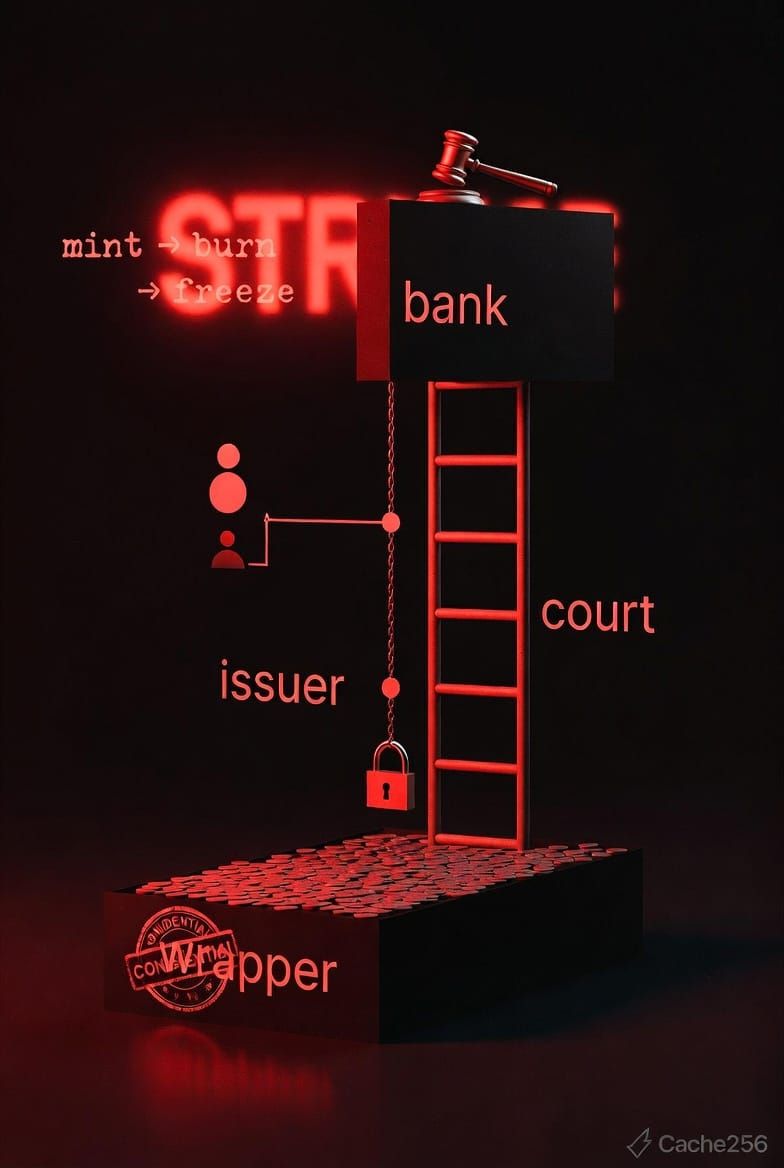
Four rungs. The control does not disappear as you move up the stack — it concentrates.
- Rung 0 — the wrapper (Zama cUSDC). Confidentiality tech. Read by some as sovereignty. In fact a view over USDC — it holds nothing it can defend, and its own founder said so.
- Rung 1 — the issuer (Circle). Holds mint / burn / freeze. Every layer above inherits its off-switch. The confidentiality tech does not sit beside the issuer; it sits on top of it.
- Rung 2 — the court, and whoever can reach it. In 2022 it took OFAC and a national-security sanction to make Circle freeze a pooled contract. In 2026 it took a private civil TRO — one plaintiff, one commercial dispute, granted ex parte, before the other side could be heard. The bar dropped. The off-switch is no longer reserved for sanctions; it is available to anyone who can obtain a restraining order. Address-level dispute, contract-level freeze.
- Rung 3 — the bank consortium (The Clearing House). The terminal form: issuance, custody, and settlement collapsed into chartered banks. No independent issuer is left to pressure, because the bank is the issuer. The chokepoint stops being a point on the rail. It becomes the rail.
// STRATEGIC MECHANICS
- Why confidentiality does not help. A wrapper inherits the redemption path of what it wraps. Freeze the underlying and the confidential balance is a claim on nothing. Privacy is orthogonal to sovereignty: it changes who can see, not who can seize. This is the operational content of Tools, Not Declarations — a proof of confidentiality is not a proof of control.
- Why the reversal does not matter. A demonstrated capability is a retained capability. The freeze lifted in about 72 hours — but it took two law firms working a weekend to undo what one plaintiff obtained ex parte in an afternoon. The court's own reversal changed nothing about the mechanic: an issuer can still blacklist a pooled contract on a court order. All it established is that the swept-in depositor has standing to be heard — that the bar to keep a freeze is higher than the bar to impose one. The default is frozen. Operators price the capability, not the docket.
- The precedent, named. This is not new architecture, and it is not new behavior. The "neutral" rail has always had an off-switch, and the state has always, eventually, pulled it. SWIFT called itself a neutral global cooperative until the EU ordered it to cut off Iran's banks in 2012 — and Russia's in 2022. Bank deposits read as bearer until Cyprus froze them behind an overnight bank holiday and haircut the large ones in 2013. And on-chain, this precise move is four years old: in August 2022, the day OFAC sanctioned Tornado Cash, Circle blacklisted the mixer's USDC pool — freezing every depositor in it, not only the sanctioned party — and stated it plainly: "Circle is a regulated company and conforms to sanctions compliance requirements." Zama, 2026, did not set a precedent. It repeated the one the issuer established in 2022 — this time on a private civil order, not a sanction. Tokenized deposits do not escape this lineage. They are its next verse.
- Why bank rails are the endgame. A tokenized deposit is not a stablecoin with a bank logo. It fuses the three functions a stablecoin keeps nominally separate — issuance, custody, settlement — inside one regulated balance sheet. That removes the last seam an operator could work: no issuer to lobby, no hearing to win, no offshore mirror. The deposit was always the bank's liability. On-chain it stays the bank's liability — now programmable, now freezable at the speed of settlement. The Clearing House says the quiet part in its own release: the point is to keep the money "anchored by regulated banks."
- The box the incumbents wrote for themselves. The asymmetry is statutory, and it is the sharpest part. The GENIUS Act boxes the payment stablecoin: one-to-one narrow reserves, and no yield to the holder — the issuer is barred from paying you interest for holding the dollar. But GENIUS excludes a bank deposit — including a deposit recorded using distributed-ledger technology — from the definition of a payment stablecoin. So the tokenized deposit is not a stablecoin. It is a bank liability: inside FDIC insurance and bank supervision, and — unlike the stablecoin it competes with — free to bear interest. The banks did not merely build a rival rail. They legislated the stablecoin into the inferior box and kept the superior one. The competitor is barred by statute from matching the yield of theirs.
// OPERATOR INTELLIGENCE
- Sort holdings by whether an issuer sits above them. Bearer assets — BTC in self-custody, permissionless overcollateralized collateral — carry no off-switch one rung up. Issuer-backed dollars — USDC, USDT, and every tokenized deposit that follows — carry one by construction. Confidential or not.
- Threat-model confidentiality correctly. A shielded balance defends you from counterparties and observers. It does not defend you from the issuer, the court, or the bank. If the entity you need privacy from is the one that can freeze you, the wrapper is the wrong tool. Tornado Cash's depositors learned this in 2022; Zama's relearned it in 2026.
- Watch the migration, not the headline. The signal is not "Circle froze funds." It is the chokepoint moving up a rung — issuer to bank — where the levers you had (pressure the issuer, win the hearing, route offshore) stop existing.
- The sovereignty premium is structural, not sentimental. It accrues, quietly, to the assets with nothing above them. Everything else is a faster receipt — and now, in the bank box, an interest-bearing one you do not control.
// TRANSMISSION ANALYSIS
The GENIUS settlement did two things at once: it made the stablecoin freezable-by-design and barred it from paying yield, and it excluded the bank's tokenized deposit from that regime entirely. The Clearing House network is the same hand from the other side — the banks building the rail that keeps the tokenized dollar inside the perimeter, "anchored by regulated banks," in their own words, and legally free to pay the interest the stablecoin cannot. Box the competitor as compliant-but-inferior; build your own rail in the exempt box. Read together, Q2 2026 is not a privacy case and a bank product and a piece of legislation. It is one movement: the on-chain dollar finished into an instrument of the perimeter, with the confidentiality layer serving as the tell. When privacy tech is sold as sovereignty, look underneath. In Q2 it was always USDC — and USDC was always Circle — and Circle was always reachable, as it has been since 2022.
Watch what the privacy protocol did next. Zama's own remedy, announced with the reversal, is what it calls transitive compliance: confidential balances will now mirror the issuer's actions on the underlying — a Circle freeze on a USDC address propagating automatically to the matching cUSDC balance. The privacy layer's answer to being frozen was not to remove the off-switch. It was to wire the off-switch in, per address, by design. That is the quarter in one move: the chokepoint is not contested. It is refined. Sovereignty theater resolves, on contact with a court, into compliance-by-construction.
The endpoint is the bifurcation this desk has mapped since July 2025. On-chain money splits into issuer/bank dollars — fast, compliant, freezable, interest-bearing inside the bank box, the overwhelming majority of volume — and a shrinking bearer layer that keeps the one property crypto was built to deliver. Putting dollars on a blockchain never removed the chokepoint. It gave the chokepoint a faster settlement layer, a better view, and now a statutory yield advantage. The operators who understood that in Q2 did not need the wrapper. They needed to know which rung they were standing on.
Not the wrapper. The rung.
// SOURCES
▸ Zama freeze — Bitcoin.com, "Zama Users Lose Access to $12.6M USDC After Circle Executes Court-Ordered Blacklist" (30 May 2026) — news.bitcoin.com (accessed 2026-07-07)
▸ Reversal — The Defiant, "US Court Lifts Circle Freeze on Zama's $12.5M cUSDC Contract After Three-Day Lockout" (2 June 2026) — thedefiant.io (accessed 2026-07-07)
▸ Bank rail — The Clearing House, "Major Financial Institutions Unveil Bank-Led On-Chain Money Initiative" (5 June 2026) — theclearinghouse.org (accessed 2026-07-07)
▸ 2022 precedent — The Block, "Circle freezes USDC funds in Tornado Cash's US Treasury-sanctioned wallets" (8 Aug 2022) — theblock.co · OFAC designation — home.treasury.gov (accessed 2026-07-07)
▸ GENIUS Act (yield prohibition + tokenized-deposit exclusion) — Arnold & Porter, "What You Need To Know About the New Stablecoin Legislation" — arnoldporter.com (accessed 2026-07-07)
▸ 2027 launch target — The Wall Street Journal, "JPMorgan, Citi and Big Banks Plan New Tokenized Deposit System to Answer Crypto" (4 June 2026) — wsj.com (accessed 2026-07-07)