Ecosystem NEAR: The L1 Where Chain Abstraction Actually Works — but the Token Still Waits on the AI-Agent Economy NEAR — co-founded by a Transformer co-author — shipped what most 'AI coins' only pitch: working chain abstraction (NEAR Intents, 35+ chains, ~$21.7B volume) and a fee-buyback flywheel, with inflation halved to 2.5%. But it's still net-inflationary and DeFi is thin (~$147M) vs a ~$2.4B cap.
Ecosystem Gala Games: Inside the Node-Powered Gaming Infrastructure Gala Games built a node-powered GameFi ecosystem where players and operators co-own gaming infrastructure. This deep analysis covers nodes, GALA tokenomics, governance risks, compliance, and why Gala positions itself as the decentralized gaming layer heading into 2026.
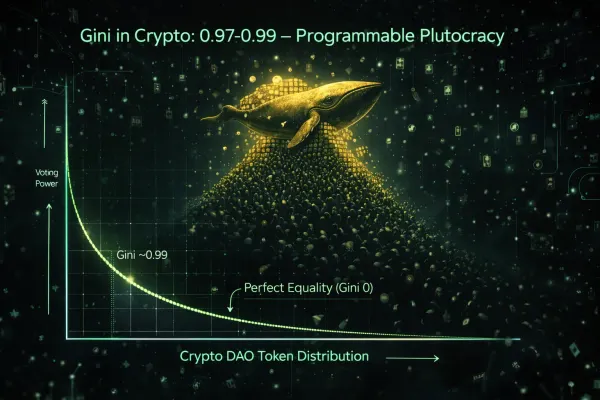
intelligence The Gini Coefficient: Measuring Extreme Token Concentration in Crypto Governance The Gini coefficient measures inequality (0=perfect equality, 1=total inequality). Derived from the Lorenz curve, it reveals extreme token concentration in crypto DAOs: 0.97-0.99 Gini—far worse than any nation (South Africa ~0.63). This exposes programmable plutocracy in governance.
Ecosystem Polkadot: Engineering Without Demand Polkadot invented the shared-security thesis the whole industry now runs on — sovereign chains sharing one security pool. It delivered Polkadot 2.0, capped supply at 2.1B DOT, and is building JAM. Yet DOT sits at all-time lows because the demand never came. Cache256 on the token-vs-tech gap.
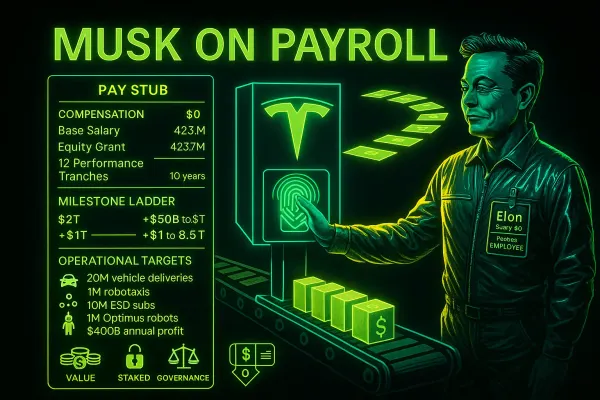
intelligence Elon Musk's $1 Trillion Tesla Pay Package: Crypto Tokenomics in Corporate Governance Tesla shareholders approved $1 trillion for Musk, the largest compensation package in history. It's not CEO pay. It's protocol alignment: staked capital with unlock conditions, governance weight via network effects.
Ecosystem Cardano: Whose Chain Is It? Cardano is crypto's paradox: 3rd globally for developer activity, near-empty for users. It runs the most complete on-chain governance in crypto — Voltaire — which just voted down its own Foundation's summit. Now the founder wants control back. Cache256 on whose chain it is.
Ecosystem DePIN INFRASTRUCTURE HUB DePIN protocols coordinate distributed resources while concentrating control through tokenomics. From Helium's connectivity mesh to Render's GPU clusters, institutional adoption signals maturation from speculation to productive asset coordination.
Ecosystem LayerZero: Trust-Minimized, Committee-Verified LayerZero is the omnichain messaging layer that actually gets used — but "trust-minimized" means a configurable committee of verifiers (DVNs), not proof. In April 2026 a $292M forged message showed what that costs, and ZRO captures almost none of the flow. Cache256: attested, not proven.
Ecosystem Render: One Company's Cloud Render is the DePIN that actually renders — 76.5M frames, real Hollywood VFX. But "decentralized" describes the GPU supply, not the control: the engine is OTOY's closed-source Octane, OTOY takes 5% of every job, and ~60k of its GPUs are borrowed from another network. Cache256: one company's cloud.
Ecosystem Filecoin: Storage Power ≠ Stored Data Filecoin is the largest decentralized storage network — but most of that capacity was empty space providers were paid to seal. Now the subsidized bubble is deflating (4.2 → 3.0 EiB) while real usage climbs to 36%: the reprice from storage power to stored data, into the Oct 2026 vesting cliff.
Ecosystem Helium: The Coverage Stayed. The Demand Was Sold. Helium built the largest crowdsourced wireless network in history — then dismantled the demand side. In 18 months: sub-DAO tokens unwound, CBRS 5G traded away, T-Mobile denying the offload deal, the free plan killed, Helium Mobile sold. What's left is coverage — and a $41.7M token.