Elon Musk's $1 Trillion Tesla Pay Package: Crypto Tokenomics in Corporate Governance
Tesla shareholders approved $1 trillion for Musk, the largest compensation package in history. It's not CEO pay. It's protocol alignment: staked capital with unlock conditions, governance weight via network effects.

NOVEMBER 2025 - last update: NOV 09, 2025
On November 6, 2025, Tesla shareholders approved the largest compensation package in corporate history: up to $1 trillion in stock for Elon Musk over the next decade. Corporate media framed it as excessive CEO pay. Proxy advisors called it "pay for unchecked power." Critics protested outside state capitols.
They all missed the signal.
This isn't compensation. It's a redesign of how value is produced, captured, and attributed in post-scarcity infrastructure. Musk transformed wage labor into protocol participation. He encoded his operational time as staked capital with unlock conditions. Tesla isn't paying him. It's issuing governance weight contingent on network effects.
Welcome to wage mechanics in the age of programmable value.
// STRUCTURAL DECOMPOSITION: WHAT IS A WAGE?
Traditional wage architecture operates on a simple equation:
user@wage-model:~$ analyze --traditional
Time × Labor Rate = Compensation
Worker sells hours.
Employer buys output.
Wage caps at time available.
Constraints:
▸ Linear scaling (more hours = more money, until limit)
▸ No upside capture (value created ≠ value received)
▸ Misalignment (employee incentive ≠ company growth)
▸ Exit liquidity (leave company, wage stops)
This model emerged from Industrial Revolution factories, where value production was mechanical and measurable. You worked 8 hours, you produced 8 widgets, you earned 8 units of pay. Simple. Predictable. Dead.
Knowledge work broke this. How do you measure the value of the engineer who writes the algorithm that 10x's efficiency? How do you compensate the strategist whose insight prevents a $1B mistake?
You don't. Not with wages. You use equity.
But equity itself was broken—until now.
// THE PROTOCOL UPGRADE: COMPENSATION AS CONDITIONAL STAKING
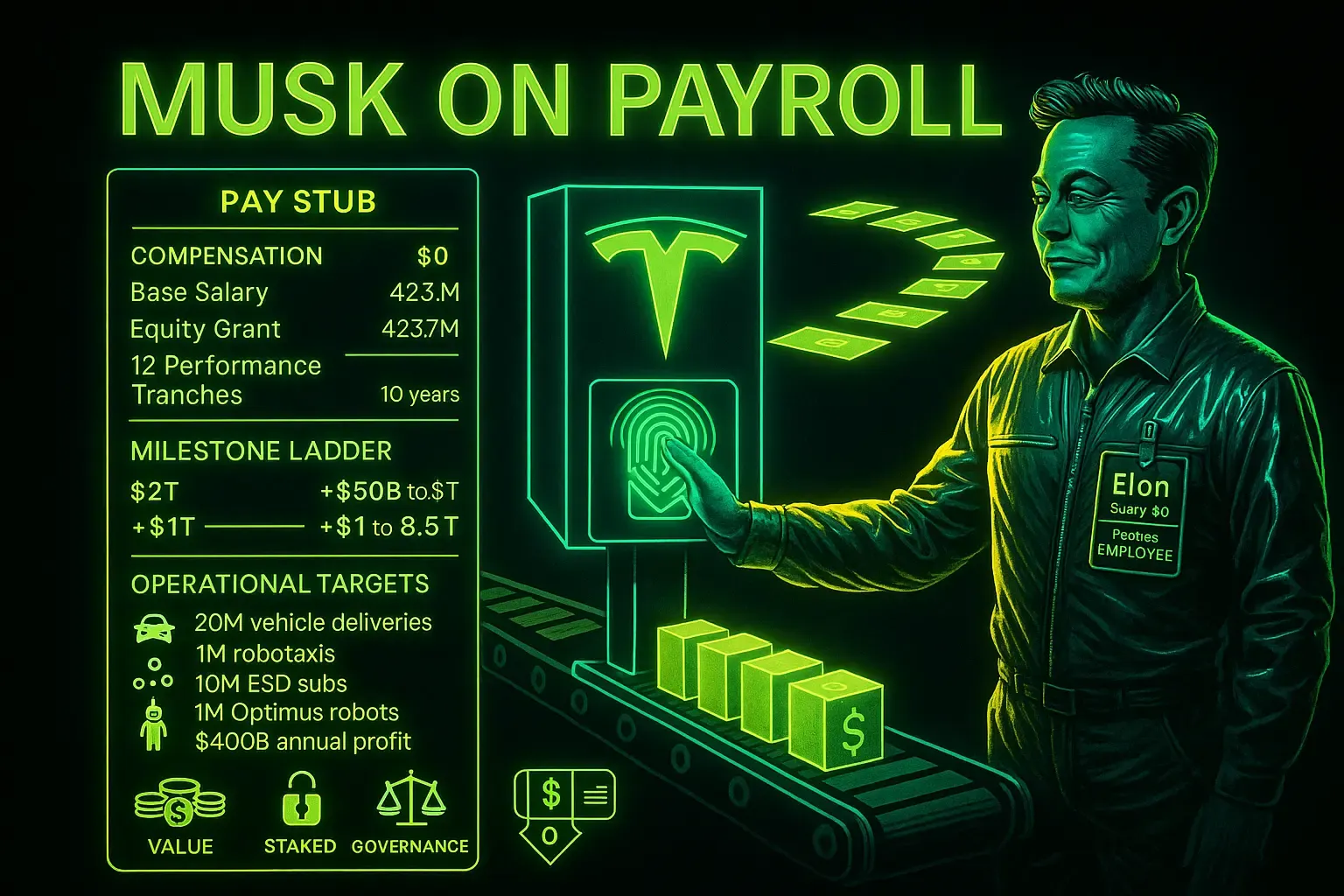
Musk's compensation isn't "pay." It's a smart contract with unlock conditions:
musk@tesla:~$ decode --package-structure
COMPENSATION MECHANICS:
Base Salary: $0
Stock Grant: 423.7M shares (12% dilution)
Vesting Period: 10 years
Unlock Mechanism: 12 tranches tied to milestones
Lock-Up: Must remain CEO for 7.5 years minimum
MILESTONE STRUCTURE:
Tranche 1: Market cap → $2T
Tranches 2-10: +$500B increments → $6.5T
Tranches 11-12: +$1T increments → $8.5T
Operational Targets:
▸ 20M vehicle deliveries (10 years)
▸ 1M operational robotaxis
▸ 10M Full Self-Driving subscriptions
▸ 1M Optimus robots delivered
▸ $400B annual profit
Current Position:
Market Cap: $1.5T
Annual Deliveries: ~2M vehicles
Robots Delivered: 0
This is proof-of-work for executive compensation. Musk earns nothing unless Tesla achieves targets that would require fundamental transformation of transportation, manufacturing, and labor economics.
Compare to traditional CEO pay:
Standard CEO Package:
• Fixed salary: $1-5M
• Annual bonus: 100-300% of salary
• Stock options: Vest over 4 years
• Performance metrics: Revenue growth, EPS, relative TSR
Result: CEO optimizes for quarterly earnings, stock buybacks, and short-term shareholder appeasement. Incentive = maintain status quo, extract dividends, exit with golden parachute.
Musk's package inverts this. No extraction until transformation. No salary. No guaranteed vest. The only way he unlocks value is if Tesla becomes the world's most valuable company while revolutionizing multiple industries.
This isn't wage labor. It's protocol alignment.
// CRYPTO PHILOSOPHY: STAKING VALUE IN NETWORK EFFECTS
The parallels to cryptocurrency economics are not coincidental. They're architectural.
Musk understands crypto mechanics intimately—Tesla holds $1.5B+ in Bitcoin on its balance sheet, deployed as treasury reserve asset. He's driven Dogecoin adoption through payments integration and public endorsement. This compensation structure applies the same primitives he's been experimenting with in crypto markets: stake, lock, govern.
Crypto Mechanics Comparison:
| Mechanism | Tesla/Musk Structure | Crypto Equivalent |
|---|---|---|
| Token Lock-Up | 12% shares, 10-year vest | 32 ETH staked (Ethereum) |
| Unlock Conditions | Milestones ($8.5T cap) | Proof of validation |
| Governance Weight | 25% voting power at full vest | veCRV (vote-escrowed CRV) |
| Slashing Risk | Dilution if targets missed | ETH slashing for misbehavior |
| Network Growth | Value scales with market cap | Rewards scale with TVL |
This is proof-of-stake for corporate governance. The person with the most capital locked in the protocol, for the longest duration, with the most skin in the game, gains decision-making authority.
Crypto natives will recognize the pattern:
Ethereum validators lock 32 ETH to secure the network. They earn rewards proportional to network usage. If they misbehave, their stake gets slashed.
Curve Finance voters lock CRV tokens for 4 years as veCRV. Longer locks = more voting power. Governance weight = commitment to protocol longevity.
Tesla's structure locks Musk's capital (current stake) + operational focus (CEO role) + future equity (new shares) for a decade. He earns proportional to network growth. If he fails targets, his stake dilutes relative to other shareholders.
The language is different. The mechanics are identical.
// THE CONTROL VECTOR: VOTING POWER AS THE REAL ASSET
Tesla's board stated explicitly: "It's less about compensation and more about the voting influence."
Critics called it "pay for unchecked power."
Both missed the architecture.
governance@tesla:~$ compare --power-structures
CURRENT POWER STRUCTURE:
Musk: 13% ownership → ~$195B stake
Institutional holders: ~45% (Vanguard, BlackRock, etc.)
Retail: ~42%
Decision-making reality:
▸ Institutions vote as block
▸ Retail fragmented across millions
▸ Musk influential but not controlling
POST-PACKAGE STRUCTURE:
Musk: 25% ownership → ~$375B stake (if targets hit)
Institutional: ~40% (diluted)
Retail: ~35% (diluted)
New reality:
▸ Musk becomes largest single stakeholder by 2x
▸ Effective control over major decisions
▸ Institutions must negotiate, not dictate
This is a protocol governance attack disguised as compensation. Musk is using shareholder approval to concentrate decision-making authority while claiming it's performance-based pay.
Sound familiar?
It's the Curve Wars. It's ve-tokenomics. It's Lido's stETH dominance on Ethereum.
When one entity controls enough stake in a protocol, they don't just participate—they direct. Musk isn't getting paid to work for Tesla. He's acquiring the voting weight to ensure no one can remove him or override his vision, regardless of short-term market pressures.
The $1 trillion number is a distraction. The governance capture is the mechanism.
// RETHINKING VALUE PRODUCTION: POST-LABOR ECONOMICS
Now zoom out. What Musk's package represents isn't just clever compensation design. It's a model for how value gets produced in economies where physical labor becomes obsolete.
Consider the targets:
1 MILLION ROBOTS DELIVERED
Tesla's Optimus robot is designed to replace human labor in factories, warehouses, homes. Musk claims they can be produced for $20K each and sold for ~$30K.
If successful, each robot replaces ~$40K/year in human labor.
1M robots = $40B in annual labor cost elimination.
Over 10 years = $400B in cumulative value creation (before accounting for capital savings, efficiency gains, etc.).
Musk's compensation = capturing a fraction of the value his robots create by replacing human wages.
This is where it gets weird.
Musk is being paid in equity (ownership of future cash flows) for building infrastructure that eliminates wage labor. His trillion-dollar "wage" comes from making wages obsolete.
The economic logic:
Industrial Economy:
Value = Labor Hours × Productivity
Wages = Share of value created by labor
Capital = Tools that amplify labor
Post-Labor Economy:
Value = Capital × Automation
Wages = Obsolete (robots work for electricity cost)
Capital = Owns both tools AND labor replacement
Result:
Workers displaced by robots.
Owners of robots capture value previously distributed as wages.
Musk's compensation = equity in the entity that automates human labor.
This is technologically-enabled feudalism with better PR.
Except there's a twist.
// THE CRYPTO RESPONSE: TOKENIZED LABOR & PROTOCOL PARTICIPATION
Traditional wage labor is dying. Musk's compensation structure proves it. But crypto offers an alternative model that doesn't require concentrating ownership in a single entity.
DECENTRALIZED VALUE CAPTURE MECHANISMS:
1. Protocol Contributions as Equity
DeFi protocols distribute tokens to users, liquidity providers, developers.
→ Value creation = value capture, distributed across participants
2. Staking as Productive Capital
Ethereum stakers lock ETH, earn ~4% APY from network fees.
→ Capital deployment = passive income, no corporate intermediary
3. DAO Labor Markets
Coordinape, Gitcoin enable peer-evaluated contributions.
→ Work compensated by protocol, not manager
4. Tokenized Skills & Reputation
On-chain credentials, NFT certificates, portable reputation.
→ Value follows worker, not employer
These models flip Musk's structure. Instead of one person capturing $1T by building automation, you get millions of people capturing value by participating in protocols.
Example:
Helium Network: Users deploy hotspots, mine HNT tokens, provide decentralized wireless coverage. They own the infrastructure. They capture the revenue. No CEO takes a trillion-dollar cut.
Livepeer: Video transcoding infrastructure. Anyone can run a node, stake tokens, earn fees from network usage. Decentralized, permissionless, value distributed to operators.
Filecoin: Storage providers earn FIL by offering disk space. Market-driven pricing, no central authority extracting rent.
This is the alternative path: same automation, different ownership structure.
// THE PHILOSOPHICAL SHIFT: WAGE AS PROTOCOL INCENTIVE
What Musk's package forces us to confront is this:
Wages were never about fair compensation. They were about control.
Employers pay wages to ensure workers show up and follow instructions. Wages are obedience mechanisms. You exchange autonomy for stability. You trade ownership for predictability.
Musk's structure makes this explicit. He won't accept wages. He demands equity. He refuses salary. He insists on ownership.
Why? Because equity = upside. Wages = cap.
But here's the thing crypto figured out: you don't need corporate equity to capture upside. You need protocol tokens.
MENTAL MODEL SHIFT:
Old World:
• Work for company → Receive wage → Cap at hours worked
• Upside captured by owners/shareholders
• You rent your time, they own the output
Musk's Model:
• Own company → Equity compensation → Unlock if targets hit
• Upside captured by largest stakeholder
• Lock time + capital, control protocol
Crypto Model:
• Contribute to protocol → Earn tokens → Stake for governance
• Upside distributed across participants
• Own output, coordinate permissionlessly
The question isn't whether wages die. It's who captures the value when they do.
Musk's answer: concentrate ownership, automate labor, capture trillion-dollar upside.
Crypto's answer: distribute ownership, coordinate permissionlessly, split upside across network.
Both models reject wage labor. Both embrace programmable value. Both align incentives through token mechanics.
The difference is one creates a trillionaire, the other creates a thousand millionaires.
// IMPLEMENTATION: HOW TO RESTRUCTURE YOUR OWN VALUE CAPTURE
Musk's package isn't just theoretical. It's a playbook. Here's how to apply it:
FOR FOUNDERS:
1. Replace salary with equity lock-up
→ Take minimum cash, maximum stock
→ Tie vesting to milestones, not time
→ Example: "No shares unlock until $10M ARR"
2. Align compensation with network effects
→ Don't pay yourself when revenue grows 10%
→ Pay yourself when revenue grows 10x
→ Exponential outcomes = exponential capture
3. Lock governance weight to performance
→ Issue voting shares only after targets hit
→ Control follows value creation, not seniority
FOR OPERATORS:
1. Negotiate equity, not salary
→ Join pre-PMF startups with meaningful %
→ Early equity > late salary (by magnitudes)
2. Demand milestone-based vesting
→ "I vest 1% when we hit $1M ARR"
→ "I vest another 1% at $5M ARR"
→ Outcome-based, not time-based
3. Build portable reputation on-chain
→ NFT credentials, DAO contributions, protocol work
→ Take ownership with you, job-hop strategically
FOR CRYPTO NATIVES:
1. Farm protocols with aligned incentives
→ Find projects distributing tokens to users
→ Provide liquidity, governance, development
2. Stake for yield + governance
→ Lock tokens long-term for voting power
→ Capture protocol revenue as staker
3. Build in public, capture value permissionlessly
→ Open-source contributions = reputation = tokens
→ Work for protocols, not companies
The common thread: stop selling time. Start staking capital—financial or reputational—in protocols that scale non-linearly.
// SECOND-ORDER EFFECTS: WHAT HAPPENS WHEN EVERYONE THINKS LIKE MUSK?
If Musk's model spreads, we get:
POSITIVE OUTCOMES:
1. Aligned Incentives
Executives focus on 10-year value, not quarterly earnings
2. Risk-Taking
Big bets rewarded, mediocrity punished
3. Meritocracy (Theoretically)
Outcomes matter more than credentials
4. Capital Efficiency
Cash preserved for R&D, not salaries
NEGATIVE OUTCOMES:
1. Wealth Concentration
Value accrues to those who already own equity
Wage workers get nothing (or robots)
2. Governance Capture
Founders use equity packages to entrench control
Shareholders vote away their own power
3. Labor Displacement
Automation incentivized, jobs eliminated
No safety net for displaced workers
4. Systemic Fragility
Entire economies dependent on handful of "protocol kings"
Musk controls Tesla → controls transportation → controls energy
Single point of failure for critical infrastructure
This is why crypto's distributed model matters. If we're restructuring compensation away from wages, the question is:
Do we concentrate value in Musks, or distribute it across networks?
// THE DEEPER PATTERN: CONTROL MASQUERADING AS INNOVATION
Strip away the rhetoric about "alignment" and "performance pay," and here's what Musk's package actually is:
A mechanism to:
1. Dilute existing shareholders (12% new shares issued)
2. Concentrate voting control (25% total stake if targets hit)
3. Lock in current leadership (7.5-year minimum CEO term)
4. Tie governance to growth targets (can't remove Musk without killing incentives)
5. Extract maximum value ($1T upside if successful)
Framed as: "Innovative compensation"
Actually is: Leveraged governance takeover with shareholder consent
Shareholders voted to dilute themselves and hand Musk unchecked power. Why?
Because they believe in the protocol.
This is exactly how crypto governance works. Token holders vote to:
- Mint new tokens (dilute themselves)
- Fund protocol development (pay insiders)
- Grant exclusive rights (concentrate power)
- Lock liquidity (reduce exit options)
All while chanting "decentralization" and "community-owned."
Musk's package and crypto governance are the same theater with different aesthetics.
// CONCLUSION: WAGE DEATH & VALUE REBIRTH
Musk didn't invent a new compensation model. He made explicit what crypto has been building quietly for years:
Value production is shifting from labor-hours to protocol participation.
Wages are dying because time is no longer the scarce resource. Coordination is.
In a world of automation, AI, and autonomous agents, the question isn't "how much can you work?" It's "what protocols do you contribute to, and how much equity do you control?"
Musk's answer: Own the protocol. Lock in control. Capture the upside.
Crypto's answer: Build the protocol. Distribute ownership. Split the upside.
Both models abandon wage labor. Both embrace programmable incentives. Both align contributions with outcomes.
The difference is who owns the protocol when the music stops.
SIGNAL SYNTHESIS:
Wages = Obsolete
The trillion-dollar package proves compensation is restructuring from time-based to outcome-based. Hourly pay doesn't scale with network effects.
Equity = New Wage
Ownership replaces salary. Upside capture replaces predictable income. Risk tolerance becomes the filter.
Protocol Alignment = Core Mechanism
Whether corporate (Tesla) or crypto (DeFi), value flows to those who stake capital and time in protocols with exponential growth potential.
Governance = Hidden Prize
The trillion dollars is theater. The 12% voting weight is the payload. Control over infrastructure beats cash compensation.
Decentralization = The Alternative
If wage death is inevitable, the question is whether value concentrates (Musk) or distributes (crypto). Both paths exist. Choose accordingly.
Musk's package isn't excessive CEO pay.
It's a protocol fork for how humans capture value in post-labor economies.
The fork is here. Pick your chain.
Code is law. Math is truth.
The future of value is programmable.