Quadratic Voting: The Only Mechanism That Makes Whales Pay Exponentially to Dominate
Standard token voting = linear plutocracy where whales dominate cheaply. Quadratic voting changes everything: costs rise quadratically, limiting concentration and amplifying intense minority preferences. From Gitcoin's proven QF to emerging DAO experiments, this mechanism forces real dispersion
last update: FEBRUARY 22, 2026
December 31, 2025. Quadratic Voting: The Only Mechanism That Makes Whales Pay Exponentially to Dominate
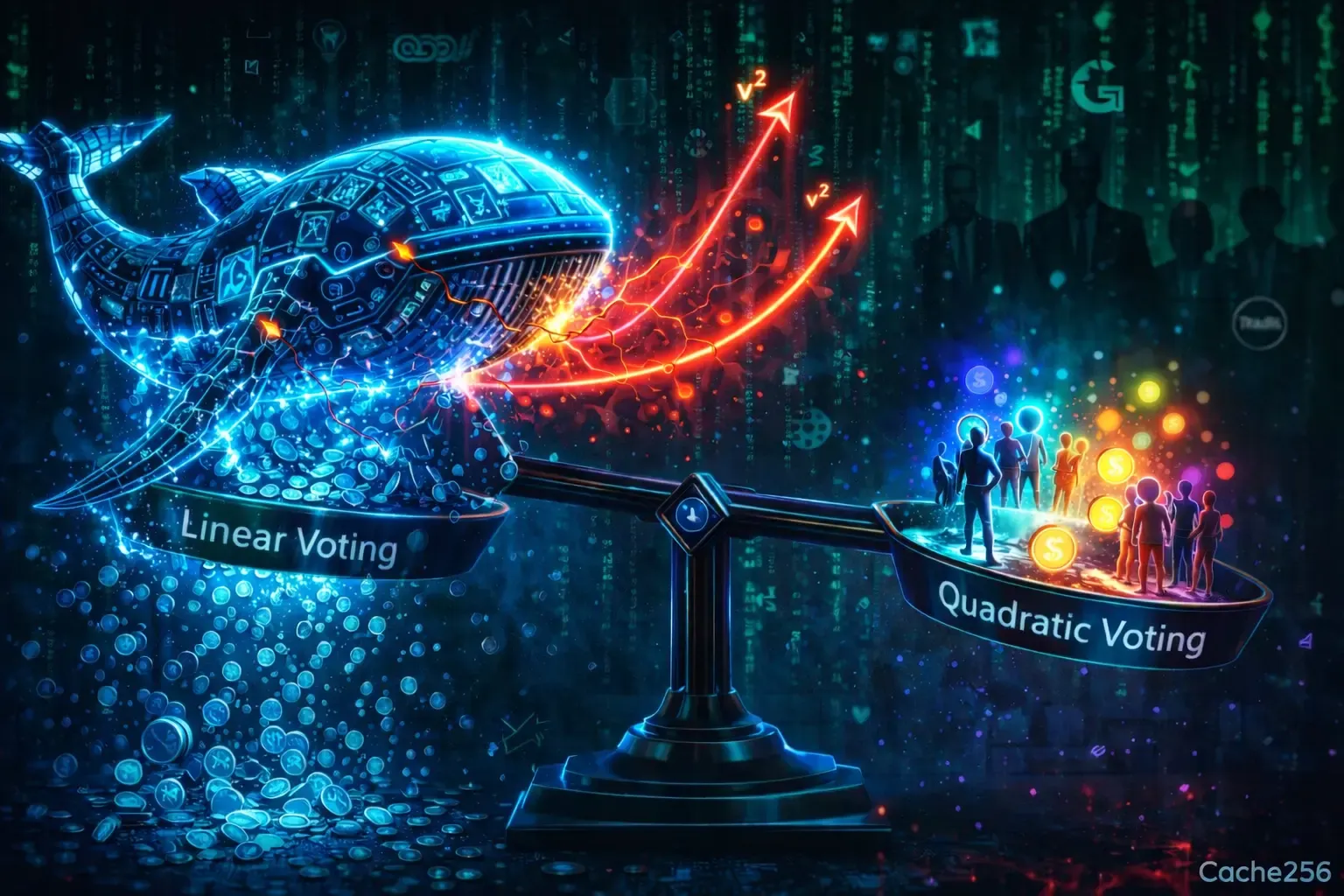
Standard token-weighted governance is linear plutocracy: one token, one vote. Whales buy influence cheaply, scale dominance without friction. Quadratic voting flips the script. Cost escalates quadratically with additional votes on any single proposal. One vote costs 1 credit. Two votes cost 4 credits total. Three cost 9. Ten cost 100. Marginal price rises linearly, total expenditure quadratically. Whales face exponential penalty for concentration. Minorities amplify intensity without matching raw capital.
Math is simple yet brutal. Voter with V voice credits allocates v_i votes to proposal i. Cost = ∑ v_i². Effective votes contributed = ∑ v_i (or sometimes √total in aggregated forms). Outcome weighted by square root of spend, not linear spend. Whale dumping 10,000 credits for 100 votes pays 10,000 for 100 effective influence if concentrated—but achieves only ~100. Spread across issues dilutes impact further. Small holder with 100 credits expressing strong preference on one issue (10 votes, cost 100) matches whale's intensity on that single point.
Cost explodes quadratically. Buying 10 votes costs 100× more than buying 1. Linear voting has no such brake.
Real-World Implementations: Gitcoin Leads the Way
This isn't theory. Gitcoin pioneered quadratic mechanics in grants since 2019, evolving into full quadratic funding (QF) rounds by 2025. Closely related: QF matches donations quadratically, rewarding breadth of support over depth from few whales. Gitcoin Grants 2025 strategy piloted dynamic QF, cluster-match for Sybil resistance, distributing millions with broader builder support. OSS rounds combined QF for early-stage with retro metrics for mature projects. Results: reduced whale skew, amplified small donors.
Direct quadratic voting implementations rarer in core DAO governance, but live. Optimism Collective experimented quadratic elements in retro funding and citizen house concepts. Taiwan's vTaiwan platform (off-chain but influential) used quadratic for policy prioritization. Snapshot supports quadratic as voting strategy alongside token-weighted. Few major DeFi DAOs adopted fully by 2025 (Uniswap, Aave stick linear), but proposals surfaced in governance forums.
Most major DeFi DAOs remain on linear voting. QV/QF adoption concentrated in grant distribution layers — not core governance (yet).
Contrast with Linear Status Quo
Contrast with token-weighted status quo. Linear voting: whale with 10,000 tokens casts 10,000 votes on proposal, cost proportional. Dominates easily. Quadratic: same whale limited to √10,000 = 100 effective votes if fully concentrated, paying full budget. To match linear dominance requires exponentially more capital. Simulations (arXiv 2025 papers on QV generalizations) show quadratic reduces Gini influence 40-70% versus linear in concentrated distributions.
Real-world proxies: Gitcoin rounds pre-2025 showed QF outperforming linear matching, redirecting funds from whale-heavy to broad-support projects. Arbitrum's Grants Stack experiments (2024-2025) used paid quadratic entries, filtering farmers while balancing stakeholder influence. Sybil detection redirected up to 70% suspicious match.
Under quadratic rules, a small holder's 100 credits buys equal intensity as the whale on any single issue — asymmetric power parity.
Barriers to Adoption & The Institutional Threat
Why scarce in production DAOs? Complexity. Voters must strategize allocation across proposals. UI friction higher than "connect wallet, vote yes/no." Gas costs for on-chain quadratic taller without optimizations. Sybil risk: fake identities multiply weak voices unless paired with PoH (Worldcoin Passport, Gitcoin integrations maturing 2025).
Yet resistance builds. Institutional capture accelerates need. BlackRock IBIT closed 2025 near $100B AUM, 50-60% spot ETF market share, custodied 3-4% total BTC supply. One entity, compliant rails, delegated stakes incoming. DAOs mirroring TradFi concentration via linear voting invite same capture: foundations, VCs, now institutions proxy-vote treasuries.
Quadratic as Structural Countermeasure
Quadratic counters structurally. Makes whale (or institutional bloc) dominance costly, visible. Forces spread or pay premium. Pairs naturally with conviction (time-weight) or soulbound reputation (non-transferable merit).
2025 experiments point forward: Optimism multi-chamber (token vs citizen quadratic elements), Gitcoin dynamic models, academic UC-secure on-chain QV protocols (ePrint 2025). Hybrid viable: linear signaling, quadratic execution for contentious.
Base Case: Theater or True Dispersion
Strategic Decision Lens: Why Actors Choose (or Avoid) Quadratic Allocation
Game theory explains the equilibrium: quadratic voting shifts Nash equilibria toward broader dispersion by raising marginal costs. But strategic decision theory reveals why whales and small holders actually behave this way under uncertainty and cognitive limits (Simon’s bounded rationality + Kahneman’s prospect theory).
Whales face a classic allocation dilemma: concentrate votes on high-stakes proposals (linear intuition: "buy more to win") or spread to minimize opportunity cost? In quadratic, the utility tree branches as follows:
Game theory under QV: all three paths sub-optimal for whales. Option A is myopic, B cognitively expensive, C exits governance entirely.
- Option A – Concentrate: Dump budget on one proposal → high immediate influence, but quadratic penalty explodes (e.g., 100 votes = 10,000 cost; effective ~100 sqrt-influence). Loss aversion kicks in: fear of "wasting" on losers outweighs long-term dispersion gains. Result: myopic over-concentration despite mechanism design.
- Option B – Spread: Allocate across 5–10 issues → lower per-proposal dominance, but higher total utility if preferences are sincere (diminishing returns avoided). Bounded rationality often blocks this: cognitive overload in multi-proposal DAOs leads to default linear heuristics ("vote everything yes/no").
- Option C – Exit / Abstain: High friction + perceived low impact → most common in low-turnout DAOs (17% average). Prospect theory: losses from gas/UI effort loom larger than uncertain governance gains.
Small holders / passionate minorities gain asymmetric advantage: intense preference on niche issue yields high utility per credit (10 votes at cost 100 matches whale's marginal spend). Decision process: higher "reference point" on conviction → willingness to pay quadratic premium for signal strength.
Matrix of key trade-offs (simplified AHP-style weighting for whale perspective, 2025 priors):
| Factor | Weight | Quadratic Score | Linear Score | Net for Whale |
|---|---|---|---|---|
| Influence per dollar | 40% | Low (diminishing) | High (linear) | - |
| Risk of overpaying (loss aversion) | 30% | High penalty visible | Hidden until backlash | + |
| Minority blocking power | 20% | Amplified | Negligible | - |
| Cognitive / UI cost | 10% | High (allocation strategy) | Low | - |
Net: whales rationally prefer linear status quo unless forced (protocol-level). Quadratic adoption requires reducing decision friction (better UI, presets) + making over-concentration visibly punitive (on-chain cost dashboards). Without, bounded rationality + institutional inertia keep 95% DAOs in theater mode.
Key insight: mechanism design wins on paper, but human decision architecture determines real outcomes. Quadratic doesn't just change costs — it changes how actors perceive and weigh their choices.
Base case without: continued whale theater, faster TradFi assimilation. With quadratic rails embedded: genuine dispersion possible. Costly to dominate, cheap to intensify minority preference.
This mechanism alone forces whales to pay real price for control. Everything else is theater.
Next: conviction voting, long-term alignment over instant capital.
No hype. Signal only. Stay sovereign.
Main Sources (data as of late 2025 or closest available):
- Gitcoin Blog posts and Grants Strategy 2025: Quadratic funding rounds, dynamic QF pilots, cluster-match results.
- Cambridge Centre for Alternative Finance and prior DAO reports: Gini comparisons, voting patterns.
- arXiv/ePrint 2025 papers: QV generalizations, UC-secure protocols, simulations vs linear voting.
- Optimism/Arbitrum governance forums and Grants Stack case studies: Retro funding, quadratic elements.
- Snapshot documentation: Supported voting strategies including quadratic.
- BlackRock filings/trackers (Bitbo.io, ETF reports): IBIT AUM ~$100B, market share 50-60%.
- Radical Markets (Weyl/Posner) foundational math; blockchain adaptations (Vitalik discussions, MDPI 2022-2025 reviews).
"This is crypto strategic intelligence. Not financial advice. You are sovereign."