Whale Dominance Endgame: Why 95% of 2025 DAOs Remain Decentralization Theater
December 2025. Flagship DAOs: 17% average turnout, Gini 0.97-0.99, top holders control 76-90%+ voting power. Institutional capture meets token-weighted plutocracy. 95% theater, not sovereignty. CACHE256 analyzes the inevitable equilibrium.
December 24, 2025. The year-end data is in, and it's merciless.
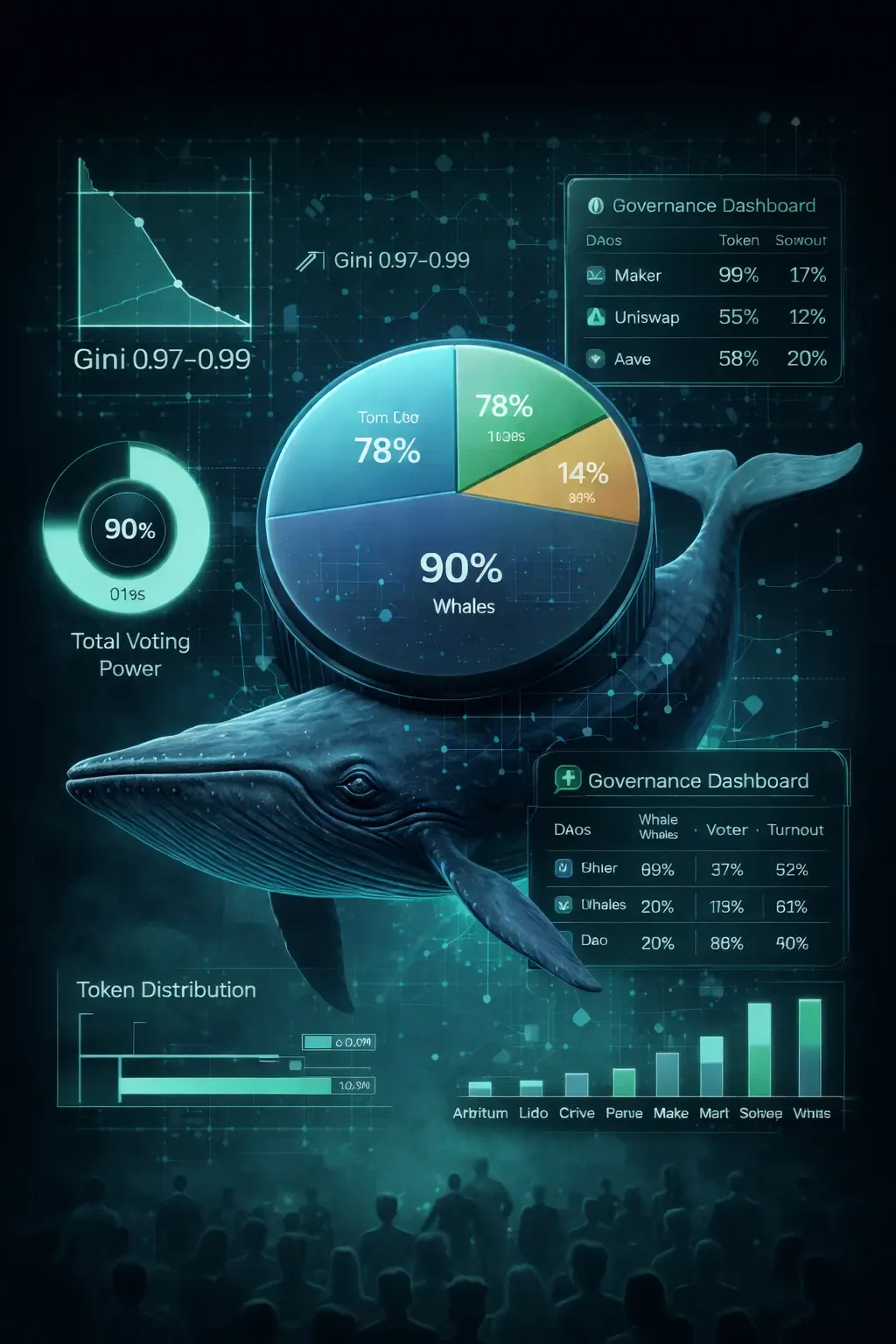
Across the DAO ecosystem, voter participation averages ~17%, with flagship protocols struggling to exceed 22-28% on critical proposals. Token distribution tells the real story: Gini coefficients for leading governance tokens hover between 0.97 and 0.99. Levels of inequality that dwarf even the world's most skewed nations (South Africa sits at 0.63). Top 10-20% of holders command 76-90%+ of voting power in most cases; outliers like MakerDAO push 0.99. Chronic apathy + hyper-concentration = programmable plutocracy, embedded by design.
Q4 2025 Metrics: Systemic Concentration
Drill into Q4 2025 metrics from Snapshot (96% of off-chain signaling), Tally (binding on-chain execution for billions in TVL), and DeepDAO trackers: Top 20 DAOs by treasury/TVL (Uniswap, Aave, Lido, Optimism, Arbitrum, Maker/Sky, Curve, Compound, Synthetix, Balancer, and others) show the same pathology. Turnout baselines at 10-17%, spiking briefly during contention before collapsing. Delegation channels some flow, but whales route power through proxies or direct votes. Single entities routinely hold 30-50% sway on treasury-impacting proposals. Quorum met minimally; outcomes often predetermined.
This isn't random variance. It's the inevitable equilibrium of token-weighted voting in a speculative market. Initial airdrops scatter supply briefly, but power-law consolidation kicks in fast. The Cambridge Centre for Alternative Finance's DeFi Navigator analysis (launched late 2024, updated through 2025) exposed it plainly: 10 major DeFi DAOs all Gini 0.97-0.99 as of October 2024 data, with Maker at 0.99 and Rocket Pool at 0.97. Consolidation accelerates post-distribution; whales accumulate dips while retail apathetic holders sit out.
Protocol Snapshots: Whale Control Patterns
Maker/Sky: Extreme Gini ~0.99; handful of large holders dictate collateral and fee decisions historically.
Uniswap: UNI skewed toward early LPs, team, VCs; top 10 addresses >50% influence in recent governance seasons; participation ~12-18%.
Aave: Staked AAVE concentration; Gini ~0.98; turnout 15-20%, delegates consolidate further.
Lido: LDO post-airdrop rapid consolidation; node operator votes dominated by large stakes.
Curve/Convex: veCRV locks amplify whales; voting battles resolved by 2-3 major lockers.
Layer 2s (Optimism/Arbitrum): Retro funding and grants dilute initially, but foundation proxies and large delegates reclaim disproportionate power by 2025.
CoinLaw's 2025 treasury report reinforces: governance power "highly concentrated; <0.1% of holders control ~90% of votes in some cases." Chainalysis DAOs Report echoes: 1% of holders often control 90% voting rights. Digitap and academic reviews (arXiv 2025 papers) confirm systemic whale sway marginalizes smaller participants. These patterns mirror fundamental power dynamics across token governance systems.
Rational Apathy: The Prisoner's Dilemma
Low turnout isn't laziness. It's rational. Small holders see their input as noise in a whale-dominated signal; participation costs (gas, time) outweigh impact. Whales engage selectively for veto or capture, not routine ops. Average 17% turnout (DeepDAO/CoinLaw 2025 aggregates) amplifies this: decisions by a self-selected minority, often aligned insiders.
Delegation was the promised fix. Boost engagement, expertise. Reality: funnels power to professional delegates (governance farmers, aligned entities), importing TradFi proxy dynamics on-chain. Cornell and Stanford blockchain research (2025) highlights whale-enabled collusion risks; concentrated votes block privacy upgrades or enable off-chain coordination.
Rails-Level Capture: Bitcoin as Mirror
Mirror this to rails-level capture: BlackRock's IBIT held 775-800k BTC by late December 2025 (3-4% total supply), with AUM fluctuating near $70-100B amid year-end outflows. One regulated custodian, institutional moat. Centralized exposure to "decentralized" asset. DAOs sold the counter-narrative: code-enforced, permissionless dispersion. 95%+ deliver LARP: VCs, foundations, early insiders, now institutions via delegated stakes, hold effective control.
Why 95%? The Base Incentives
Base incentives favor concentration. Spec tokens flow uphill; airdrops → farms → whales. Apathy loop: low turnout empowers whales → disengagement deepens. Institutional inflows (pension/treasury proxies) accelerate TradFi importation.
Pathology in action: 2025 governance attacks. Proxy wars in L2s over fees; attempted treasury drains via coordinated proposals; off-chain signaling ignored by on-chain whale execution. BeInCrypto/DL News chronicled: whale skew distorts outcomes, marginalizes retail.
Alignment persists. Whales rarely raid outright (destroys bag value). Interests converge on extraction/growth, but true dispersion stifled. Innovation vetoed; smaller voices muted. System selects plutocratic equilibrium over radical sovereignty.
Base Case Forward: Entrenchment
TradFi inflows projected $200B+ combined ETF AUM 2026; delegated stakes mirror corporate concentration on-chain. Turnout drops; apathy hardens. DAOs morph into shareholder vehicles, not cypherpunk networks. Institutional capture accelerates across infrastructure layers.
Resistance Requires Protocol Surgery
Immutable anti-concentration: quadratic voting (exponential cost for excess influence); conviction (time-locked accumulation rewards commitment over capital); soulbound reputation (non-transferable contribution proofs); sybil-resistant PoH (Worldcoin Passport integrations). Multi-chamber hybrids (token vs citizen houses) emerging in Optimism/Lido experiments.
Alternative frameworks like Aragon and DAOstack experiment with modular governance primitives, but face the same base incentive challenges.
Rely on "community maturation" or delegation tweaks? Naive. Code immutable constraints, or embrace the theater. Smart contracts as governance infrastructure can either enforce decentralization or entrench control. Institutional capture dominates rails and governance. Feature, not bug.
Signal: 2025 Governance Ledger Closes
This closes 2025's governance ledger. Upcoming: mechanics that fight back. Quadratic rails, conviction, SBTs, futarchy.
For strategic approaches to DAO participation and governance mechanisms, see our DAO Governance Playbook.
No hype. Signal only. Stay sovereign.
Main Sources (data as of late 2025 or closest available):
- Cambridge Centre for Alternative Finance (CCAF) DeFi Navigator report (December 2024 launch, updates through 2025): Gini coefficients 0.97-0.99 for top 10 DeFi DAOs.
- DeepDAO and CoinLaw 2025 statistics: Average voter participation ~17%; governance token holders >6.5M; concentration trends.
- Chainalysis DAOs Report: 1% holders often control 90% voting rights.
- DL News and BeInCrypto coverage of CCAF findings (2024-2025).
- Bitbo.io and BlackRock filings/trackers: IBIT holdings ~775k BTC, AUM fluctuations.
- Academic papers (arXiv, Journal of Corporate Finance 2025 reviews): Whale dominance, plutocracy risks.
- Snapshot/Tally on-chain aggregates for turnout and concentration patterns.