GENIUS Act: The Loophole Closes — Yield Ban Final Rules & Where the Money Goes
One year on, the GENIUS Act yield ban gets its final rules. The OCC's rebuttable presumption closes the exchange-reward loophole — and the displaced yield is migrating to tokenized deposits. Dr. Alexandra Volkov maps where the money goes.

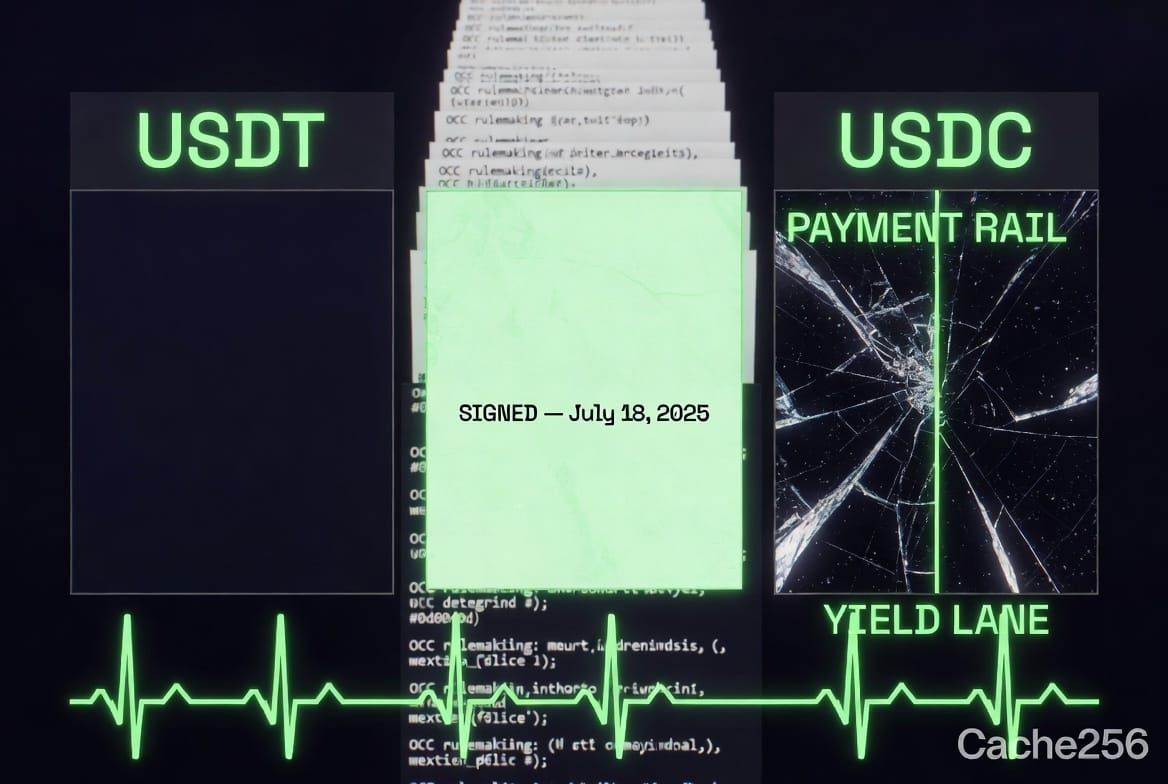
In April we wrote that the GENIUS Act had drawn the first wall and the OCC was filling in the mortar. The open question was whether exchange reward programs — USDC yield on Coinbase, yield-equivalent products marketed by fintechs — could survive as legally distinct from issuer-level yield. Three months later, the rulemaking answered it. They cannot.
Section 4(a)(11) bans issuers from paying holders yield for holding a stablecoin. The OCC's proposed rule adds the piece that gives it teeth: a rebuttable presumption that an issuer violates the ban when it routes yield through an affiliate or related third party — a white-label partner, a service provider, an exchange — that then pays the holder. The indirect lane, the one Circle's institutional moat quietly depended on, is presumed illegal by default. Coinbase's USDC rewards, Ethena's sUSDe distribution, CEX reward programs generally — all now sit inside the perimeter, not beside it.
The statutory deadline for final rules is July 18, 2026 — one year after enactment. As of early July the rules are landing unevenly: proposals out across the OCC, FDIC, Treasury and NCUA, comment periods closed through May and June, several finals still pending. The wall may not be fully mortared by the anniversary. But the direction is set, and the economically decisive question is no longer whether the loophole closes. It is where the displaced yield goes when it does — because it does not disappear. It changes landlords.