Crypto Week: Institutional Infra Capture Accelerates Amid Market Rout
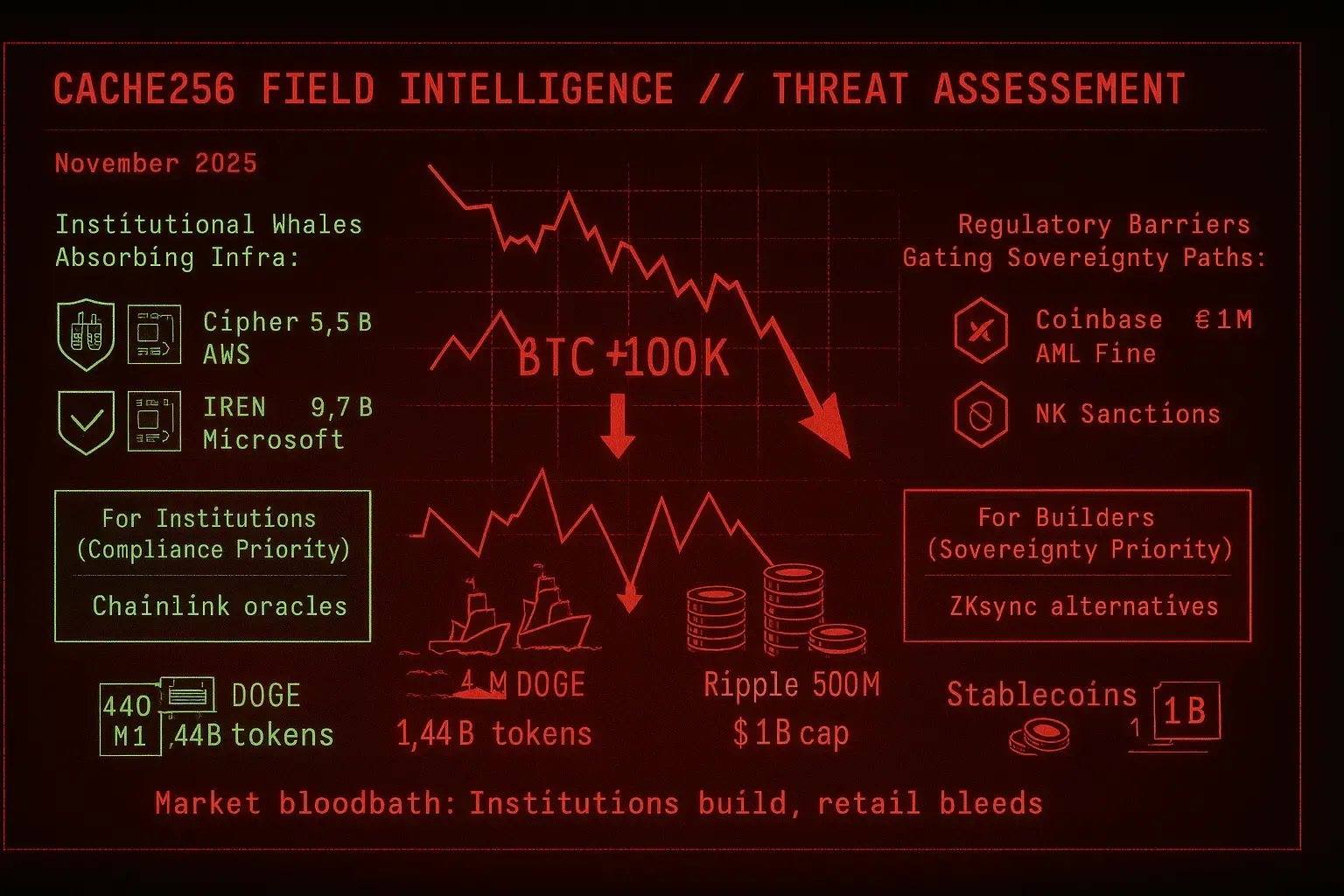
Market bloodbath reveals infrastructure capture physics: Bitcoin miners shift 1.5GW to AI compute (Cipher $5.5B AWS, IREN $9.7B Microsoft), Ripple raises $500M from TradFi giants, Coinbase fined €21M for AML gaps. Elite capital consolidates during volatility while retail liquidates. Position wisely

// FIELD INTELLIGENCE
Market bloodbath: BTC below $100K, alts down 5-12%, $1.6B liquidations. Infra pivots: Mining firms to AI, Ripple $500M raise at $40B val. Regulation tightens: Coinbase €21M AML fine, NK sanctions. Adoption mixed: Stablecoins hit $1B, but hacks rattle DeFi. Patterns: Whales sell, institutions build. Here's the signal.
// THREAT ASSESSMENT
The Pattern:
Capital concentrates. Institutional players absorb crypto infra during downturns. Not ideology - physics of scale. This week: Mining firms pivot to AI (Cipher, IREN, MARA), Ripple raises $500M from Citadel/Fortress. Regulation follows: Coinbase fined €21M for AML gaps, NK hackers sanctioned for $2B crypto thefts. Market rout amplifies: Whales dump 440M DOGE, 1.44B tokens in pressure zones. Systemic: Elite capital positions while retail bleeds.
The Mechanism:
Infra convergence: Bitcoin miners redeploy power assets for AI (e.g., Cipher's $5.5B AWS lease, IREN's $9.7B Microsoft deal). 1.5GW+ capacity shifts from decentralized mining to centralized compute. Funding: Ripple's $40B val locks in TradFi backers, expanding custody/prime brokerage. Regulation enforces: Ireland's fine exposes monitoring failures on €176B transactions - creates detection gaps criminals exploit, but also compliance barriers for smaller players. Market: Institutional selling breaks supports (DOT 12%, SUI 9%), whales rotate out amid liquidity crunch.
For Institutions (Compliance Priority):
This solves real problems: Regulatory clarity (e.g., Bermuda's Chainlink pilot for stablecoin oversight) enables safe entry. AML fines force better monitoring, reducing risk exposure. Infra pivots provide stable revenue (AI contracts vs BTC volatility). For risk managers, this IS the feature - legal certainty, counterparty protection.
For Builders (Sovereignty Priority):
This creates constraints: Mining centralization (top firms control GW-scale power) reduces network decentralization. Funding rounds favor gated access (VC terms, TradFi strings). Fines raise barriers - smaller protocols can't afford compliance overhead, pushing toward centralized custodians.
Trade-Off Analysis:
Gained: Institutional liquidity ($500M raises, $9.7B deals) stabilizes sectors. Lost: Permissionless access - infra lock-in to elite players (e.g., Nasdaq reprimands for unapproved buys). Feature for corporates (revenue certainty), bug for independents (higher entry costs). Both valid. Different contexts.
Key Vectors:
→ Infra Capture: Miners to AI shifts control from PoW networks to tech giants (AWS/Microsoft). For institutions: Diversifies revenue. For builders: Reduces mining decentralization - trade-off energy efficiency vs network sovereignty.
→ Governance Pressure: Fines/sanctions (Coinbase, NK) enforce centralized monitoring. For compliance teams: Mitigates risk. For privacy-focused devs: Chills innovation (e.g., Samourai 5-year sentence).
→ Market Manipulation: Whale dumps (DOGE, HBAR) during routs. For large holders: Profit rotation. For retail: Forced liquidations - trade-off liquidity provision vs price suppression.
Implications: Could lead to Scenario A: Deeper TradFi absorption (more pivots, fines drive consolidation). Scenario B: Backlash builds alternatives (e.g., ZKsync tokenomics revamp for utility). Scenario C: Hybrid - regulated stablecoins (RLUSD $1B cap) bridge but gate access. Depends on enforcement: Light touch enables growth; heavy hand stifles.
The Question:
Not if institutions enter. Which priorities do you optimize for - compliance gates or sovereignty alternatives?
// TACTICAL ADVANTAGE
What This Week Unlocks (Legitimate Benefits):
Rout reveals opportunities. Institutions bring scale: Ripple's $500M enables custody expansion, stablecoin growth (RLUSD $1B cap). Mining pivots (Cipher/IREN) create dual-use infra - AI revenue funds BTC holdings. Regulation clarifies: Bermuda pilot embeds on-chain compliance (Chainlink Proof of Reserve), enabling tokenized assets (VanEck VBILL on Aave). These aren't trivial - unlock $867T tokenization potential, per Chainlink.
For Institutions:
- → Compliance tools: NAVLink oracles provide verifiable reserves, solving audit gaps. Real benefit: Legal certainty for treasuries, reduced fraud risk (e.g., post-FTX).
- → Revenue diversification: AI deals ($9.7B Microsoft) hedge BTC volatility. Specific problem solved: Energy cost stability for corporate holders (Strategy's $45M BTC buy).
For Mainstream Adoption:
- → UX improvements: Google integrates Polymarket/Kalshi odds - normalizes prediction markets. Safety: Regulated pilots (Mastercard/RLUSD settlements) build trust.
AND, Alternative Opportunity Spaces:
For actors with different priorities - permissionless paths exist. Rout creates entry points: Oversold alts (ICP +35-38%) signal rotation potential.
For Permissionless Builders:
- → DeFi gaps: Balancer $116M exploit exposes vulnerabilities - build audit-resistant protocols (e.g., ZKsync utility revamp). Uncaptured: High-yield alternatives to hacked venues.
- → Infra alternatives: Ethereum Fusaka upgrade (PeerDAS) scales blobs without centralization - deploy L2s for sovereignty-focused apps.
For Sovereignty-Focused Operators:
- → Tokenomics plays: Proposals like ZKsync/Hyperliquid funds reward communities - launch similar for decentralized ecosystems.
- → Global venues: Non-US clarity (Canada stablecoin regs, Bermuda pilots) enables offshore builds - position in UAE/HK for less gatekeeping.
Different Tools, Different Priorities: Institutions get compliance bridges (Ripple partnerships). Builders get rout-driven innovation space (oversold assets, exploit lessons). Both suited to contexts - not good vs bad.
// OPERATOR ACTIONS
Here's what you do now.
If Your Priority = Regulatory Compliance:
- → Audit monitoring: Post-Coinbase fine, deploy Chainlink oracles for reserves. Why it makes sense: Meets AML (e.g., €21M avoidance), enables institutional entry.
- → Pivot infra: Like miners, assess dual-use power - AI contracts fund BTC. Timeline: Q4 pilots, 2026 deployment.
- → Fundraise gated: Follow Ripple - target TradFi VCs for custody expansion.
If Your Priority = Permissionless Infrastructure:
- → Exploit routs: Buy oversold (ICP/NEAR gains) - rotate from dumps (DOGE whales). Why it makes sense: Sovereignty over volatility - avoid institutional flows.
- → Build alternatives: Post-Balancer hack, fork audit-proof DeFi. Use Fusaka for L2 scaling - deploy privacy mixers (contra Samourai risks).
- → Global position: Use Canada/Bermuda clarity - launch stablecoins offshore. Timeline: Now testnet, Q1 mainnet.
If You Need Both:
- → Hybrid pilots: Like Mastercard/RLUSD - settle fiat on-chain with compliance wrappers. Navigate trade-off: Custody for institutions, on-chain for users.
Timeline:
Q4: Rout bottoms - position buys. Q1 2026: Fusaka live - scale L2s. Ongoing: Monitor fines/sanctions - pivot to clear jurisdictions.
The Tactical Read:
Week shows infra concentration (mining pivots, Ripple raise) amid rout. For compliance actors: Legitimate stability through regulation. For sovereignty builders: Opportunity in alternatives (Fusaka, ZKsync). Both valid. Different contexts. Feature for some, bug for others. CACHE256 focuses on sovereignty plays - build the alternatives.
Position accordingly.
// RELATED CACHE256 INTELLIGENCE
INFRASTRUCTURE CAPTURE
• Institutional Adoption Hub • L2 Myths: Decentralization Theater • Ethereum Developer Crisis
REGULATORY FRAMEWORKS
• MiCA vs U.S. Crypto Regulation • Stablecoins Payment Revolution • Circle USDC Infrastructure
MARKET DYNAMICS
• $19B Liquidation: DEX Resilience • $500B Crash Analysis • $1.2B Consolidation Analysis
WEEKLY TRENDS