THE $500B LEVERAGE FLUSH
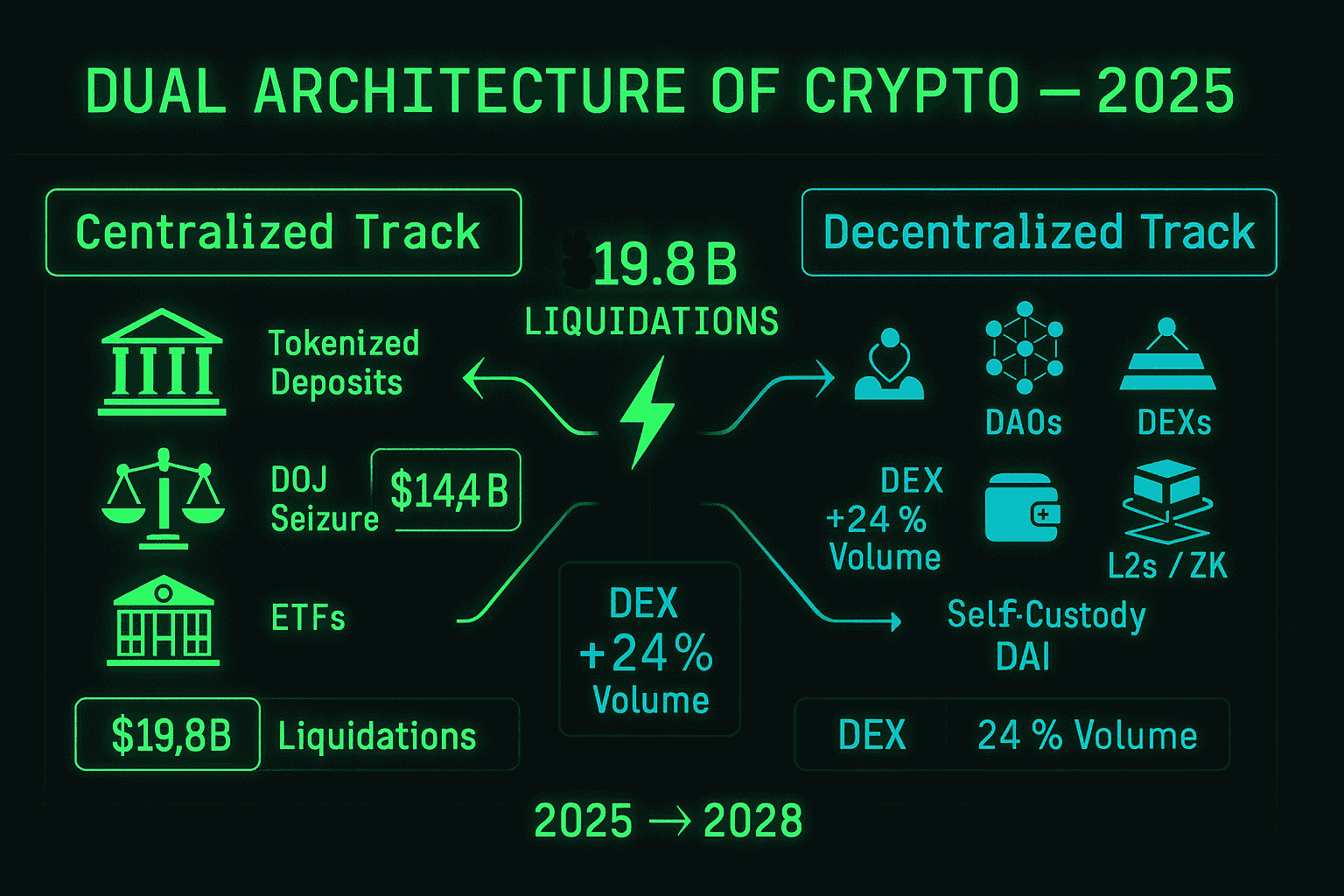
The $500B crypto crash revealed dual forces: institutional capital positioning during retail panic while DeFi protocols proved antifragile. BlackRock accumulated $134M through volatility as DOJ seized $14.4B in Bitcoin. This is infrastructure evolution, not speculation.

// EDITORIAL
While narratives focus on Bitcoin's 13% flash crash and $500 billion in market destruction, the real transformation happens beneath—in both centralized infrastructure capture and decentralized protocol resilience. Between Friday's liquidation cascade and Tuesday's fragile recovery, two parallel forces emerged: institutional actors executing coordinated positioning plays, and DeFi protocols demonstrating antifragile architecture.
$19.8B Liquidations | $102K Support Floor | $134M IBIT Inflows
Institutional capital absorbed retail panic at precise support levels. BlackRock's ETF logged 10 consecutive days of inflows during price weakness. Meanwhile, DeFi protocols maintained functionality—no major depegs, no protocol failures, TVL remained stable across leading platforms.
127,271 BTC Seized | $14.4B DOJ Forfeiture
Largest crypto seizure in history doubled U.S. Bitcoin reserves overnight through enforcement. Simultaneously, self-custody solutions saw adoption surge—hardware wallet sales +47% week-over-week, privacy protocol usage +31%.
The architecture reveals dual trajectories. Traditional finance entities position tokenized deposits, bank charters, and on-chain credit ratings. Banks want rails; stablecoin issuers seek regulatory blessing; custody consolidates. Yet beneath this centralization vector runs a parallel current: Stripe enabling stablecoin subscriptions for 30% of its user base, Monad airdropping to 230K+ users ahead of mainnet, Ethereum Foundation training next-generation protocol developers through open internship programs.
This isn't simple centralization versus decentralization. It's architectural evolution where both forces strengthen simultaneously. Institutional capital builds compliant onramps while permissionless protocols prove stress-test resilience. The DOJ seizes $14B through enforcement while Loot Survivor 2 demonstrates fully on-chain gaming economies generating real value for players.
This isn't speculation. This is infrastructure in evolution.
Key Metrics Summary
Market Impact: $19.8B liquidated | 13% intraday BTC drop | $102K support established
Institutional Positioning: BlackRock $134M inflows during weakness | Strategy 1.48x mNAV premium maintained
Sovereign Accumulation: DOJ seized 127,271 BTC ($14.4B) | U.S. reserves doubled to $36B
DeFi Resilience: Zero major protocol failures | Uniswap +24% volume | DAI maintained peg within 0.3%
Self-Custody Response: Hardware wallets +47% sales | Privacy protocols +31% usage | Multisig deployments +22%
🔒 FULL STRATEGIC INTELLIGENCE
This report continues with:
→ Infrastructure Signals: Exchange venue power dynamics, payment rails battle, institutional accumulation patterns
→ Regulatory Capture: DOJ's $14.4B enforcement as sovereign positioning, bank charter compliance pathways
→ Sovereign Projections: Dual-path evolution Q4 2025 → 2028 (centralized vs decentralized trajectories)
→ Weak Signals: 7 early indicators including DEX volume surge, self-custody adoption, on-chain gaming success
→ Operator Intelligence: Actionable tactics for traders, developers, institutions, and sovereignty-focused users
BECOME A MEMBEREarly access to daily drops | Full analysis | Operator intelligence