intelligence WEEK 38 Crypto Trends (September 15 – September 21, 2025) Week 38 reveals deepening crypto-finance integration through institutional treasury expansions and regulatory developments. Analysis covers market signals, infrastructure shifts, and corporate adoption trends shaping the evolving landscape.
intelligence How Interest Rate Cuts Affect Stablecoin Yields and Mixed Treasury Products The Fed’s September 2025 rate cut compresses yields on stablecoins and tokenised Treasuries. Yet, inflows continue to rise as institutions adopt these instruments as strategic liquidity tools, reinforcing their role in the digital financial ecosystem.
intelligence WEEK 36 Crypto Trends (September 01 – September 07, 2025) Week 36 in crypto features U.S. regulatory collaboration and ECB stablecoin scrutiny, alongside innovations like Solv-Chainlink and BRC20's EVM integration. Amid volatility, watch for harmonization impacts and infrastructure outcomes.
Ecosystem Ethereum - The Invisible Foundation of Smart Contracts For a decade Ethereum was the coordination layer and the Ethereum Foundation was its coordinator. In 2026 the EF deliberately shrank — cutting 20% of staff and 40% of its budget — as ETH entered its "third iteration." The moat in stablecoins, RWA, and lending still holds.
Ecosystem Aave: The Institutional Credit Layer of DeFi Aave stopped being "the flash-loan protocol." In 2026 it's DeFi's #1 lender turned institutional credit layer—issuing GHO, paying sGHO savings, running Horizon RWA past $600M—as its independent DAO stewards quit, accusing Aave Labs of a power grab.
Ecosystem Uniswap: The Burn and the Consolidation Uniswap invented the AMM and won the DEX category — but for five years its token captured nothing. UNIfication (Dec 2025) finally flipped the fee switch as a burn: 100M UNI (~$596M) gone, Labs' front-end fees zeroed, the Foundation folded into Labs. Cache256 on value capture — and consolidation.
Ecosystem LayerZero: Trust-Minimized, Committee-Verified LayerZero is the omnichain messaging layer that actually gets used — but "trust-minimized" means a configurable committee of verifiers (DVNs), not proof. In April 2026 a $292M forged message showed what that costs, and ZRO captures almost none of the flow. Cache256: attested, not proven.
Ecosystem Chainlink Oracles: The Invisible Data Bridge for DeFi Chainlink stopped being "an oracle." In 2026 it's the trust, interop and compliance layer institutional tokenization runs on — ~68% oracle share, CCIP across 70+ chains, SWIFT and DTCC on board. Yet LINK sits ~85% below its peak. Cache256 on the chokepoint, ACE, and who captures the value.
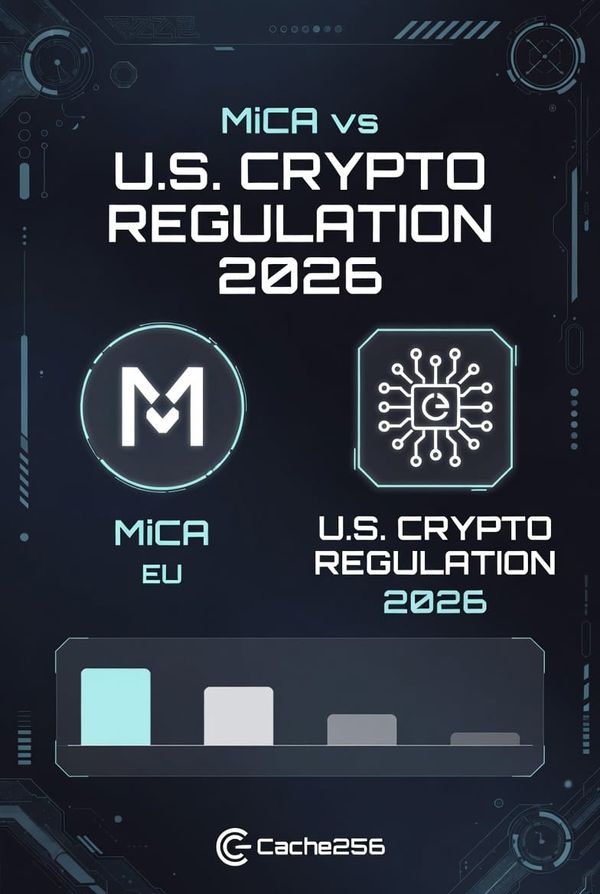
intelligence MiCA vs U.S. Crypto Regulation In 2025, Europe’s MiCA delivers unified crypto regulation, while the U.S. pursues fragmented but innovation-driven laws like the GENIUS Act. Divergent models, global stakes.
intelligence Institutional Surge Reshapes Crypto Infrastructure BlackRock, Fidelity, and other giants push billions into ETH, BTC, and DeFi infrastructure. Record ETF inflows, corporate reserves, and validator accumulation mark a turning point in institutional crypto adoption.
intelligence Wall Street's $3.6T Crypto Conquest Wall Street deploys $3.6T into BNB, ETH, and SOL, seizing validator control and reshaping blockchain power. Inside the battles for crypto’s future.
intelligence Institutional Crypto Adoption Hub Institutional crypto adoption isn't integration—it's capture. From MicroStrategy's $2.8B Bitcoin treasury to BlackRock's ETH dominance, traditional finance is rewriting crypto rules. Week 31: BTC breaks $119K via alignment acceleration.
intelligence ▲ Patterns of Power: Between Tokens and Trust Power is shifting onchain. Cardano votes, BitMine's ETH dominance, and Goldman-backed tokenisation mark a turning point for decentralised governance.
intelligence Real World Assets: The On-Chain Extraction Begins Real World Assets are reshaping DeFi—not for decentralization, but for programmable custody. RWAs encode the old system into smart contracts.
intelligence Stablecoin Wars: Polymarket's Sovereignty Test Stablecoins aren't innovation. They're control. Polymarket weighs a native token to escape Circle. Western Union pivots to survive. PNC routes crypto through Coinbase. Three vectors, one question: who owns the rails? STRIKE//ΔCT maps the four-layer stablecoin control stack.
intelligence Institutional ETH Accumulation Reshapes Market Structure Ethereum is no longer neutral ground. Institutional players are accumulating ETH and shaping on-chain strategy through ETFs, treasuries, and regulation.
intelligence Innovation Is a Syntax of Control Innovation isn’t neutral. In Web3, smart contracts and tokenization don’t democratize: they encode who holds access, custody, and execution rights.
intelligence Signal: Bitcoin’s $300K Options Bet - Power or Peril? $600M in BTC call options say $300K. But this isn’t about price: it’s about institutional scaffolding, custody leverage, and control via volatility.