RWA Tokenization 2026: From $30B to Trillion-Scale Rails
RWA tokenization exceeded $18B in 2025, led by treasuries and private credit. BlackRock BUIDL dominates; MiCA drives EU clarity. This is infrastructure consolidation. Analysis of custody, oracle risks, institutional playbooks, and control points shaping programmable finance into 2026.

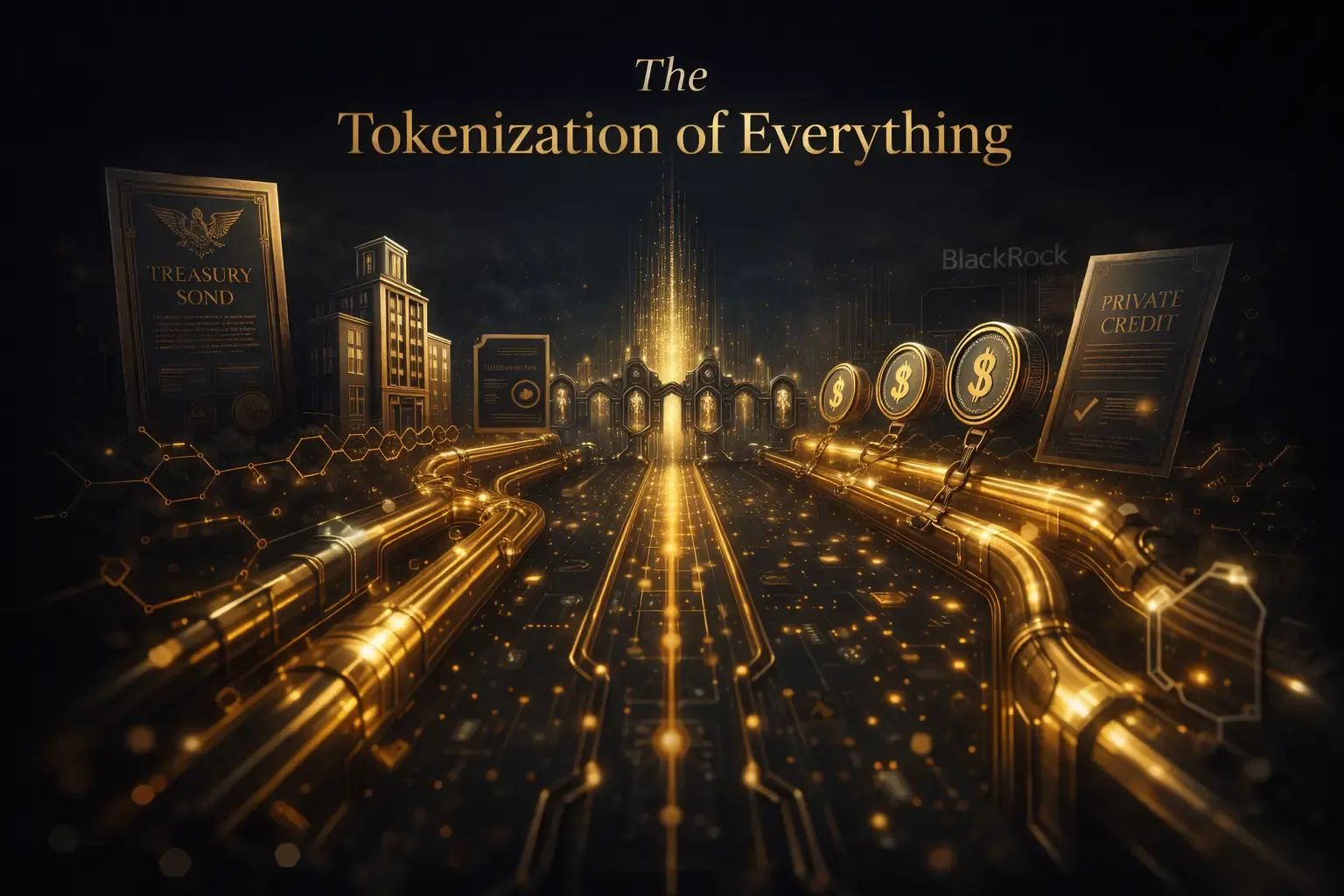
CACHE256 Strategic Intelligence | December 2025
The real-world asset tokenization market crossed $30 billion in 2025, marking a 400% expansion in three years. This isn't adoption—it's infrastructure capture. BlackRock's $2.5B BUIDL fund, Franklin Templeton's cross-chain treasury strategy, and MiCA's EU regulatory framework signal a shift: tokenization is no longer a blockchain experiment. It's becoming the settlement layer for traditional finance.
By 2030, projections range from $3.5T to $30T in tokenized assets. But scale obscures structure. The question isn't if RWAs reach trillion-dollar rails—it's who controls the custody, oracles, and regulatory gates that determine what qualifies as "real" in tokenized finance.
Current State:
→ Total RWA Market: $30B+ (excluding stablecoins)
→ Growth Rate: 260% H1 2025 alone
→ Asset Breakdown:
• Private Credit: ~$17B (58%)
• US Treasuries: ~$8.2B (34%)
• Real Estate: ~$1.8B (6%)
• Commodities: ~$600M (2%)
Dominant Chains:
→ Ethereum/L2s: 82% of RWA protocols
→ Provenance: $12B+ in tokenized assets
→ Solana, Avalanche, Polygon: emerging institutional rails
The concentration isn't accidental. Infrastructure follows custody relationships, and custody follows regulatory licensing.
BlackRock: The Collateral Colonizer
BUIDL Strategy (March 2024 - Present):
→ Launch: $1.8B → Peak: $2.9B (mid-2025) → Current: $2.5B
→ Mechanism: Tokenized T-bills as institutional collateral
→ Distribution: 7 blockchains
(Ethereum,
Solana,
Avalanche,
Polygon,
Arbitrum,
Optimism,
BNB)
→ Key Partnership: Securitize (transfer agent + custody wrapper)
Control Points Decoded:
1. Collateral Lock-In: BUIDL accepted on Binance, Deribit, Crypto.com = institutional traders must hold BlackRock product to access leverage
2. Custody Concentration: BNY Mellon as cash/securities custodian + Securitize as digital wrapper = dual-layer control
3. Minimum Entry: $5M institutional threshold = retail excluded by design
4. Cross-Chain Strategy: Multi-chain presence isn't decentralization—it's omnipresence. BlackRock captures settlement flows regardless of chain preference.
August 2025 Correction:
→ $447M outflow from BUIDL-I (Ethereum)
→ Signal: Not a retreat. Rebalancing across chains as institutional strategies mature.
Franklin Templeton: The Multi-Chain Compliance Engine
BENJI/FOBXX Strategy:
→ BENJI (Franklin OnChain US Govt Money Fund): $420M
→ First Mover: First US-registered mutual fund using public blockchain as system of record (2021)
→ Cross-Chain Deployment:
Ethereum,
Avalanche,
Polygon,
Stellar
→ Differentiation: Full mutual fund compliance + blockchain settlement
Strategic Angle: Franklin Templeton doesn't just tokenize assets—they're testing which regulatory wrapper scales best across jurisdictions. BENJI is a compliance sandbox disguised as a fund.
Custody Architecture
The Three-Layer Problem:
1. Legal Custody (Off-Chain):
→ SPVs (Special Purpose Vehicles) hold asset title
→ Trust structures map token ownership to legal claims
→ Failure Point: "Orphan tokens"—on-chain ownership without legal enforceability
→ Example: 2023 European tokenization disputes over unclear title transfer clauses
2. Digital Custody (On-Chain Keys):
→ Multi-sig wallets: BitGo, Fireblocks, Anchorage Digital, Copper
→ MPC (Multi-Party Computation): removes single-point failure
→ Vulnerability: HSM misconfiguration, key backup exposure
→ Control Point: Custodian continuity. If custodian halts, tokens become "legally inert."
3. Compliance Custody (Gate-Keeping):
→ KYC/AML at token transfer level (ERC-3643, ERC-1400 standards)
→ Whitelist enforcement
→ Power Dynamic: Custodian decides who can hold, not just what they hold
Custody Concentration Risk:
→ BlackRock BUIDL: BNY Mellon (assets) + Securitize (tokens) + select crypto custodians (keys)
→ Single Point of Regulatory Failure: If BNY Mellon or Securitize faces regulatory action, entire token ecosystem freezes
Oracle Infrastructure: The Data Authority Layer
What Oracles Control:
→ Asset valuation feeds
→ NAV (Net Asset Value) updates
→ Proof of Reserve (PoR) attestations
→ Performance metrics (loan payments, rental income, cash flows)
→ Redemption triggers
Oracle Providers:
→ Chainlink: Dominant institutional oracle, Proof of Reserve standard
→ RedStone: Canton Network integration ($6T tokenized assets, $300B daily volume)
→ Securitize Oracle Layer: Off-chain legal event triggers (lien filings, insolvency, redemptions)
Control Points Decoded:
1. Oracle Manipulation Risk:
→ Delayed price feeds = arbitrage opportunities
→ Single-source attestations = trust concentration
→ Mitigation: Multi-party attestations (custodian + auditor + bank signatures)
2. Legal Oracle Problem:
→ Smart contracts can't enforce off-chain legal outcomes
→ Oracles must translate legal events (foreclosure, default, lien) into on-chain triggers
→ Gap: If legal oracle fails or is compromised, token holders have claims without recourse
3. Reserve Attestation as Power:
→ Proof of Reserve = verifiable backing
→ But: Who audits the auditor? Chainlink PoR depends on custodian data feeds
→ Example: Canton Network uses RedStone oracles for $6T in tokenized repos, loans, MMFs
→ Concentration: If RedStone feed fails, settlement halts for trillions in institutional positions
Emerging Oracle Standards (2025-2026):
→ Cryptographic proofs (Merkle roots)
→ Signed timestamps
→ Tamper-evidence mechanisms
→ SLA requirements for freshness (e.g., 15-minute update intervals)
Framework Overview
Markets in Crypto-Assets Regulation:
→ Effective Date: June 30, 2024 (stablecoins), December 30, 2024 (all CASPs)
→ Transition Period: Until July 1, 2026 (full compliance deadline)
→ Scope: EU-wide harmonized framework for crypto assets
Token Categories Under MiCA:
1. E-Money Tokens (EMTs):
→ Backed by single fiat currency
→ Strict reserve requirements, redemption rights
→ Effect: Forces USDT delisting, USDC gains market share (72% growth in 2025)
2. Asset-Referenced Tokens (ARTs):
→ Backed by basket of currencies or commodities
→ RWA tokenization fits here
→ Detailed whitepapers, governance, audits required
3. Crypto-Asset Service Providers (CASPs):
→ Exchanges, custodians, wallet providers
→ License required by December 30, 2024
→ 18-month grandfathering period (ends July 2026)
MiCA Control Points
1. Single License, EU-Wide Access:
→ Obtain CASP license in one member state → operate across EU
→ Winner: First movers with capital to navigate BaFin (Germany), AFM (Netherlands), AMF (France)
→ Loser: Small platforms without compliance infrastructure
2. Reserve & Transparency Requirements:
→ Full liquid asset backing for EMTs/ARTs
→ Regular transparency reports
→ Mandatory reserve audits
→ Effect: High barriers to entry, favors established institutions
3. Transaction Caps on Non-EU Stablecoins:
→ 1M transactions daily OR €200M payment value
→ Intent: Protect Euro dominance
→ Result: Restricts utility, forces compliance or exit
4. Dual Licensing Trap (March 2026):
→ EMT custody/transfer may require both MiCA + PSD2 (Payment Services Directive 2) licenses
→ Implication: Doubles compliance costs, favors banks with existing payment licenses
EU RWA Growth Catalyst (2026)
Why MiCA Accelerates Tokenization:
→ Regulatory Clarity: Eliminates fragmentation across 27 member states
→ Institutional Confidence: Clear legal framework = reduced risk premium
→ Cross-Border Settlement: Harmonized rules enable EU-wide RWA markets
→ Germany's eWpG + MiCA Alignment: By end-2026, full coordination between national electronic securities law and EU MiCA framework
Predicted EU Dominance:
→ Tokenized green bonds (ESG advantage)
→ Real estate tokenization (€6T potential market if 1% of €630T global real estate tokenizes)
→ Wholesale CBDC integration with RWA settlement
However:
→ Regulatory arbitrage during transition (Netherlands vs. Italy timelines)
→ Supervisor inconsistency (ESMA audits show varying enforcement intensity)
→ High compliance costs may drive issuers to Switzerland (DLT Act) or UK (Digital Securities Sandbox)
Scenario A: Institutional Capture (70% Probability)
Characteristics:
→ BlackRock, JPMorgan, Goldman Sachs dominate issuance
→ Securitize, BNY Mellon, State Street control custody
→ Chainlink, RedStone monopolize oracle infrastructure
→ MiCA creates two-tier system: compliant institutions vs. DeFi "gray zone"
Outcome:
→ RWAs reach $100B+ by end-2026
→ Trillion-dollar scale by 2028-2030
→ But: Tokenization becomes "TradFi with smart contracts"—efficiency gains without power redistribution
→ Retail access limited to: (a) ETF wrappers, (b) fractionalized platforms with KYC gates, (c) centralized exchanges
Power Flows:
→ Custody concentration = regulatory choke point
→ Oracle control = valuation authority
→ MiCA licensing = European market gatekeeping
Scenario B: Fragmented Growth (25% Probability)
Characteristics:
→ Regulatory divergence: EU (strict), US (fragmented), Asia (experimental)
→ Multi-chain fragmentation without interoperability standards
→ Security incidents (oracle manipulation, custody hacks) slow institutional adoption
Outcome:
→ RWAs reach $50-80B by end-2026
→ Growth stalls around $500B-$1T (2028-2030)
→ Cause: Liquidity fragmentation, compliance complexity, custody failures
Scenario C: DeFi Parallel Rails (5% Probability)
Characteristics:
→ Protocol-native RWAs bypass traditional custody (e.g., MakerDAO RWA vaults)
→ Zero-knowledge proof solutions solve privacy/compliance trade-off
→ Decentralized oracle networks mature (no single point of control)
Outcome:
→ Tokenization bifurcates: institutional (MiCA-compliant) vs. DeFi (protocol-sovereign)
→ Total market smaller ($30-50B by 2026) but architecturally distinct
→ Long-term: More resilient against institutional capture
For Institutions
What to Control:
1. Custody Relationships: Secure licenses with Securitize, Anchorage, BNY Mellon before Q2 2026 MiCA deadline
2. Oracle Integrations: Dual-source feeds (Chainlink + RedStone) to avoid single-point dependency
3. Jurisdictional Strategy: EU license for distribution, US for innovation (regulatory arbitrage)
What to Avoid:
→ Single-chain lock-in (remain chain-agnostic until settlement standards emerge)
→ Generic ERC-20 wrappers (use ERC-3643 for compliance baked into token logic)
→ Oracle latency (15-minute feed delays = arbitrage vulnerability)
For Operators & Builders
Where the Leverage Is:
1. Compliance Infrastructure: KYC/AML middleware, legal oracle services, custody connectors
2. Interoperability Layers: Cross-chain RWA bridges (e.g., Wormhole for BUIDL)
3. Data Verification Services: Independent PoR audits, multi-party attestation networks
What Scales:
→ Tokenization-as-a-service platforms (Securitize model)
→ Regulated secondary markets for tokenized assets
→ Institutional-grade wallet infrastructure with built-in compliance
What Doesn't:
→ Pure blockchain plays without legal wrappers
→ Single-jurisdiction strategies (cross-border is mandatory for scale)
→ Consumer-grade custody for institutional assets
For Investors
Where Asymmetric Opportunity Exists:
1. First-Mover Licensed Platforms (EU):
→ Companies securing MiCA CASP licenses Q1 2026
→ Tokenization platforms with existing custody partnerships
→ Oracle providers expanding institutional client base
2. Compliance Middleware:
→ KYC/AML solutions for tokenized transfers
→ Legal oracle providers
→ Interoperability standards (cross-chain settlement protocols)
3. Infrastructure, Not Assets:
→ Custodians with dual (crypto + securities) licensing
→ Multi-chain oracle networks
→ Institutional wallet providers (BitGo, Fireblocks, Copper)
Where Risk Concentrates:
→ Single-chain RWA platforms (liquidity fragmentation)
→ Platforms without MiCA strategy (EU market exit by July 2026)
→ Assets without clear legal recourse (orphan tokens)
→ Oracle-dependent protocols with single data source
Thesis: Infrastructure Captures Value, Not Assets
1. Custody & Transfer Agent Infrastructure
→ Why: Every tokenized asset requires licensed custody + legal wrapper
→ Plays: Securitize (BlackRock partner), Anchorage Digital (OCC-chartered bank), BitGo (multi-sig custody)
→ Risk: Regulatory capture by incumbents (BNY Mellon, State Street)
2. Oracle Networks
→ Why: $6T+ tokenized assets depend on Chainlink/RedStone feeds
→ Plays: LINK (Chainlink), oracle infrastructure protocols
→ Risk: Oracle manipulation, centralization around 2-3 providers
3. Compliance Middleware
→ Why: MiCA + US securities law require KYC at transfer level
→ Plays: Token standards (ERC-3643 adoption), identity verification layers
→ Risk: Regulatory change, commoditization
4. Interoperability Protocols
→ Why: BUIDL deployed on 7 chains = cross-chain settlement is institutional requirement
→ Plays: Wormhole (BlackRock's bridge), LayerZero, Axelar
→ Risk: Security exploits, bridge hacks
5. Regulated Secondary Markets
→ Why: Tokenized private credit needs liquidity without regulatory risk
→ Plays: Platforms with ATS (Alternative Trading System) licenses, EU MTF (Multilateral Trading Facility) operators
→ Risk: Fragmented liquidity, regulatory restrictions
What NOT to Buy
Avoid:
→ Generic RWA tokens without legal recourse
→ Platforms without MiCA licensing strategy
→ Single-chain protocols (fragmentation risk)
→ Projects claiming "decentralized custody" (legal contradiction)
→ Anything promising "disruption" without regulatory clarity
Red Flags:
→ Custody with single provider (no redundancy)
→ Oracle feeds from single source (manipulation risk)
→ Legal wrappers in offshore jurisdictions (enforcement problems)
→ Unclear redemption mechanisms (exit trap)
Key Catalysts
January 2026:
→ DAC8 directive (EU tax transparency) takes effect
→ RWA platforms must implement automatic reporting
→ Watch: Compliance cost announcements, platform consolidations
March 2026:
→ PSD2 + MiCA dual licensing requirement begins for EMT custody
→ Watch: CASP license applications, custody provider M&A
July 1, 2026:
→ Final MiCA compliance deadline (all grandfathering periods end)
→ Watch: Platform exits from EU market, license approvals, enforcement actions
Q2 2026 (Projected):
→ BlackRock BUIDL crosses $5B (current trajectory)
→ Franklin Templeton expands BENJI to 10+ chains
→ Watch: Institutional allocations, tokenized ETF launches
Leading Indicators
1. Custody Concentration Metrics:
→ If >80% of tokenized assets flow through 3-5 custodians = regulatory capture confirmed
→ Data Source: RWA.xyz, DeFiLlama custodian breakdowns
2. Oracle Dependency:
→ Track % of RWA protocols using single oracle provider
→ Threshold: >70% = systemic risk
3. MiCA License Velocity:
→ Number of CASP approvals Q1-Q2 2026
→ Baseline: 40+ licenses issued as of October 2025
→ Projection: 150+ by July 2026 = adoption accelerating
4. Cross-Border Volume:
→ EU-US-Asia tokenized asset flows
→ Watch: If EU share exceeds 40% = MiCA competitive advantage confirmed
5. Liquidity Concentration:
→ Secondary market trading volume by platform
→ Risk Signal: If 80/20 rule applies (80% volume on 20% of platforms) = fragmentation failure
RWA tokenization in 2026 isn't about technology—it's about who owns the pipes.
The $30B to Trillion-Scale Path:
→ Custody: BlackRock/BNY Mellon model = institutions control legal + digital layer
→ Oracles: Chainlink/RedStone duopoly = valuation authority centralized
→ Regulation: MiCA = EU gatekeeping, US fragmentation, Asia experimentation
Power Redistribution: Minimal
Tokenization improves settlement efficiency, fractional access, and 24/7 trading. But the control layer—custody, oracles, licensing—remains institutionally concentrated. RWAs won't decentralize finance. They'll make TradFi programmable.
The Question for 2026:
Do you position for efficiency gains within institutional rails? Or do you wait for custody alternatives and decentralized oracle networks to mature?
The market has already answered. Institutions are deploying. DeFi alternatives are theoretical.
⚡ OPERATIONAL DIRECTIVE ⚡
Operators: Build where licensing exists.
Investors: Own infrastructure, not assets.
Everyone else: Track custody concentration.
Trillion-scale rails are coming. The architecture is already decided.
CACHE256 | Strategic Intelligence
December 2025 | Subject to quarterly revision
Tags: #RWA #Tokenization #BlackRock #MiCA #Institutional-DeFi #Custody #Oracles #Regulatory-Capture
SEO Keywords: RWA tokenization 2026, BlackRock tokenized assets, best RWA investments 2026, MiCA regulation, tokenized real estate, institutional crypto, custody control points
SOURCES & VERIFICATION
Data synthesized from:
→ RWA.xyz tokenization market reports (Q2-Q3 2025)
→ Securitize BUIDL fund disclosures
→ ESMA MiCA implementation tracker
→ Chainlink Proof of Reserve documentation
→ Boston Consulting Group/ADDX RWA projections ($16T-$30T by 2030-2034)
→ RedStone/Canton Network integration announcements
→ DeFiLlama TVL data
All figures accurate as of December 2025. Market conditions evolve rapidly. Verify independently before operational deployment.
METHODOLOGY DISCLAIMER:
CACHE256 provides analytical intelligence, not investment advice. This analysis reflects public data and observable market structures. Readers are responsible for independent verification and compliance with applicable regulations. No warranties regarding completeness, accuracy, or timeliness.
For inquiries: @cache_256 on X