The $130K Question: When Privacy Costs Less Than a Yacht
Bitcoin spends $58M/day to lock down its $2.3T network. Monero? Just $130K/day for $6.3B, making 51% attacks accessible to anyone. The 2025 Qubic attack proved it: when pure decentralization meets economics, vulnerability wins. Analysis of existential risks for privacy coins.

Category: Network Security / Existential Risk Analysis
Classification: Public Intelligence
The Math That Should Keep You Up at Night
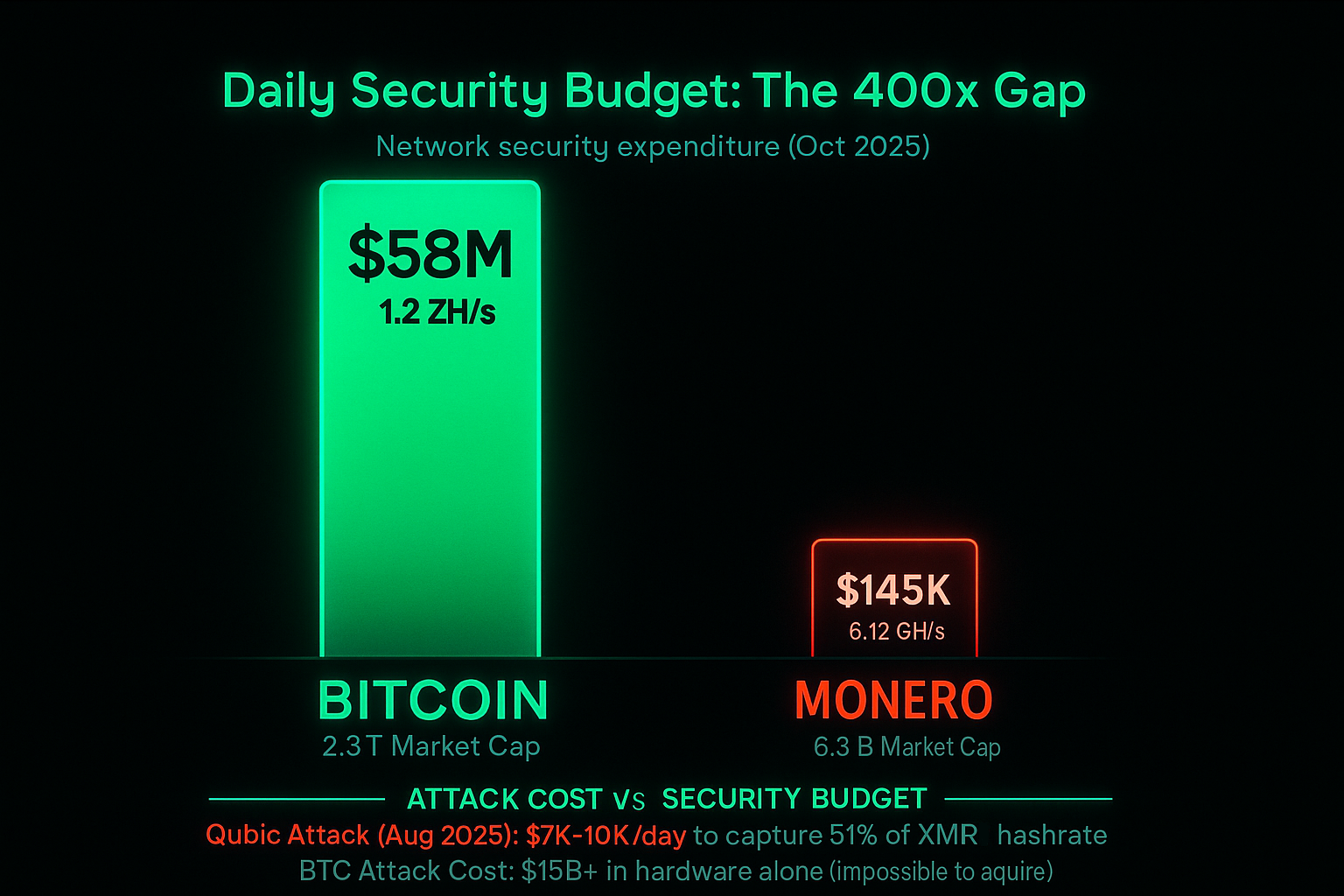
Bitcoin miners earn $58M daily to secure a $2.3T network.
Monero miners earn $145K daily to secure a $6.3B network.
That's a 400x difference in security budget for a 365x difference in market cap.
In August 2025, Qubic proved the thesis: they captured 51% of Monero's hashrate for less than $10K/day. Six-block reorganization. Network panic. Community scramble. The attack cost less than chartering a mid-size yacht for a weekend.
This isn't about Monero vs Bitcoin tribalism. This is about understanding what security actually costs, and what happens when you can't afford it.
Daily Security Budget: The 400x Gap
Network security expenditure (Oct 2025)
BTC Attack Cost: $15B+ in hardware alone (impossible to acquire)
Security Isn't Optional Infrastructure
Here's what $58M/day buys Bitcoin:
- 1.2 ZH/s of computational brute force
- Geographic distribution across continents
- ASIC hardware measured in exahashes
- Energy infrastructure rivaling small nations
- Economic incentives that make attacking more expensive than mining honestly
Here's what $145K/day buys Monero:
- 6.12 GH/s of CPU hashpower
- RandomX algorithm (ASIC-resistant by design)
- 15,000+ P2Pool decentralized nodes
- Community vigilance as primary defense
- A proven vulnerability that cost $7K-10K/day to exploit
The security model fundamentally differs. Bitcoin uses hardware barriers. You need billions in specialized ASICs to compete. Monero uses accessibility. Anyone with a CPU can mine, preventing ASIC centralization.
The paradox: Accessibility enables decentralization. Accessibility enables economic attacks.
The Qubic Attack Changed Everything
August 2025. Qubic Network needed hashrate for their own blockchain. Solution: economically incentivize Monero miners to switch. They offered slightly better rewards than XMR mining. Within days, 51%+ of Monero's hashrate migrated.
No sophisticated exploit. No zero-day vulnerability. No state-level attack. Just simple economics.
Result: Temporary network control, 6-block reorg, community crisis
Duration: Multiple days before community response
The uncomfortable truth: When your security budget is $145K/day, any actor with $11K/day can theoretically control your network. That's not nation-state territory. That's "motivated hedge fund" territory.
Compare: A 51% attack on Bitcoin would require capturing 600+ EH/s. Current hardware costs alone exceed $15B, not counting the electricity to run it or the impossibility of acquiring that much hardware without moving markets. Bitcoin's attack is measured in billions and geopolitical will. Monero's was measured in thousands and economic incentives.
| Network | Daily Security | Attack Cost | Attack Feasibility |
|---|---|---|---|
| Bitcoin | $58M/day | $15B+ hardware | Nation-state only |
| Ethereum | $240B staked | 33% stake req. | Economically infeasible |
| Monero | $145K/day | $10K/day | Proven feasible |
What Happens When Hashrate Collapses
Scenario: A hostile actor sustains a 51% attack on Monero. Not a one-time reorg. Continuous control.
Immediate effects:
- Transaction reversal (double-spend risk)
- Network censorship (selective transaction blocking)
- Exchange panic (trading halts)
- Community fragmentation (emergency hard fork debates)
- Miner exodus (legitimate miners abandon sinking ship)
Second-order effects:
- Price collapse (confidence evaporates)
- Exchange delistings accelerate (already happening)
- Developer morale crater (volunteers question viability)
- P2Pool migration (but attackers can join P2Pool too)
- Protocol fork wars (community splits on response)
Existential outcome: Network becomes unusable for its intended purpose. Privacy guarantees mean nothing if transactions don't settle reliably. The darknet merchants who comprise 80% of usage migrate to alternatives. Humanitarian users trapped. Ideology collides with reality.
The recovery path: Emergency hard fork to change PoW algorithm. Community coordination under attack conditions. Hashrate rebuilds from zero. Trust rebuilds slower. Some never return.
The Tail Emission Gamble
Monero solved one existential risk (Bitcoin's declining block subsidy) by creating another (perpetual inflation).
Bitcoin's Security Endgame
- Block subsidy approaches zero by 2140
- Transaction fees must rise to sustain security
- Fee market becomes crucial (Lightning offloads small txs)
- Risk: If fees stay low, hashrate collapses, network vulnerable
Monero's Security Endgame
- Perpetual 0.6 XMR/block tail emission (~$204/block)
- Infinite inflation at ~0.87% annual rate (decreasing as % of supply)
- Miners always have base reward regardless of fee market
- Risk: Inflation forever, no scarcity premium
Monero chose "always pay miners something" over "scarcity maximalism." This ensures miners stick around even if transaction volume craters. Smart, except when "something" equals $145K/day and attacks cost $10K/day.
The question nobody wants to ask: What happens when tail emission still isn't enough? If XMR price declines, that $204/block becomes $100/block, then $50/block. Security budget collapses further. Attack cost stays constant or decreases.
Bitcoin's bet: Fees will rise as value increases (already $350-400M/day revenue). Monero's bet: Inflation will sustain security even if price declines.
Both bets have failure modes.
Why This Matters Beyond Monero
This isn't schadenfreude about privacy coins. This is a stress test of fundamental blockchain security assumptions.
The uncomfortable pattern:
- Network security scales with miner revenue
- Miner revenue scales with token price x (subsidy + fees)
- If price crashes, security crashes
- If security crashes, price crashes harder
- Death spiral
Bitcoin escapes this because:
- Massive institutional adoption (ETFs, corporate treasuries, government reserves)
- Reserve asset status (digital gold narrative validated)
- $58M/day security budget creates enormous economic moat
- First-mover advantage = Lindy effect (survived 15+ years)
Ethereum escapes this because:
- Switched to Proof-of-Stake (economic security, not hardware)
- DeFi ecosystem generates fees ($240B TVL)
- Staking rewards sustain validator participation
- Layer-2s expand utility while securing L1
Monero has:
- Ideology (privacy is human right)
- Underground adoption (darknet, humanitarian)
- No institutional interest (compliance impossible)
- $145K/day security budget (economic attack surface)
The lesson: Security isn't free. You pay for it with inflation, fees, or institutional capture. Choose your poison.
The Decentralization vs Security Tradeoff
RandomX was designed to prevent ASIC centralization. Mission accomplished. Anyone with a CPU can mine. No specialized hardware monopoly. Pure decentralization.
Unintended consequence: Pure economic attack surface.
If mining required $5M ASICs, casual miners couldn't participate. But neither could casual attackers. The capital barrier protects the network. Bitcoin's "centralization" via ASIC manufacturers is actually a security feature. You can't rent 600 EH/s on AWS.
Monero's accessibility means you CAN rent enough CPUs to attack. Qubic didn't build custom hardware. They just economically incentivized existing miners to switch. No moat. No hardware barrier. Just better per-hash returns.
The paradox gets worse: P2Pool was supposed to solve this. 15,000+ decentralized mining nodes, no pool operator to compromise. Brilliant. Except when attackers can economically incentivize individual P2Pool miners to switch. Decentralization doesn't help if the economic incentive is universal.
The hard truth: Maybe some centralization is necessary for security. Not governance centralization. Economic and hardware barriers that make attacks prohibitively expensive. Bitcoin's ASIC moat. Ethereum's staking capital requirements. Monero has neither.
CACHE256 Assessment
Monero is a thought experiment becoming reality. Can privacy-maximalist, truly decentralized cryptocurrency survive in a world of economic attacks and regulatory pressure?
August 2025 says: Barely.
The network survived the Qubic attack through community response, but the vulnerability remains. $145K/day security budget is existential risk, not acceptable tradeoff. If price declines, budget shrinks. If budget shrinks, attacks become cheaper. If attacks increase, price declines harder.
The path forward:
- Seraphis/FCMP++ upgrades (2026) enhance privacy but don't fix economics
- Price increase raises security budget (but requires adoption)
- P2Pool dominance (but economic attacks still work)
- Community acceptance that economic attacks are the cost of accessibility
The real question: Is $145K/day enough to secure $6.3B if attackers don't want to sustain attacks? Qubic did it for hashrate, not to destroy XMR. What happens when motivated adversary (nation-state, intelligence agency, competitor) decides continuous attack is worth $10K/day?
Answer: Monero becomes unusable. Community forks. Network fragments. Privacy experiment ends.
Bitcoin doesn't have this problem because $58M/day > nation-state attention span for most countries. Ethereum doesn't have this problem because PoS slashing makes attacks cost billions (33% stake to finalize) and you lose your stake when caught.
Monero has this problem because accessibility was the design goal.
Future Scenarios Analysis
The Question You Should Be Asking
Not "Will Monero survive?" Not "Is privacy worth the risk?"
The real question: "What does security actually cost, and who pays?"
Bitcoin: Institutional capture pays. ETFs, corporate treasuries, government reserves fund security through price support. $58M/day works because massive entities need the network secure.
Ethereum: DeFi ecosystem pays. $240B TVL generates fees. Stakers lock capital. Economic incentives align.
Monero: Ideology pays. Tail emission + darknet adoption sustains miners. Community vigilance compensates for economic vulnerability. But ideology doesn't scale like capital.
The uncomfortable math:
- Security scales with economic incentives
- Economic incentives scale with price and adoption
- Privacy coins face regulatory exile
- Regulatory exile reduces price and adoption
- Reduced adoption lowers security budget
- Lower security budget enables attacks
- Attacks destroy remaining adoption
This is the death spiral.
Bottom Line
$145K/day buys you a security budget that can be overpowered by a motivated individual with a credit line. $58M/day buys you a security budget that requires nation-state resources to threaten.
This isn't a bug. This is the fundamental tradeoff:
- Accessibility enables decentralization
- Decentralization enables economic attacks
- Economic attacks require security budget
- Security budget requires price support
- Price support requires adoption
- Adoption requires compliance
- Compliance destroys privacy
Monero chose privacy over compliance. The cost is economic vulnerability.
The real lesson isn't about Monero specifically. It's about understanding that security has a price tag. You can pay it with inflation (tail emission), institutional capture (ETFs), ecosystem utility (DeFi fees), or ideology (community vigilance).
But you must pay it.
When your security costs less than a yacht rental, you don't have security. You have hope.
Hope isn't infrastructure.
Think About This
- What happens to Bitcoin's security when block subsidy drops below transaction fees?
- What happens to Ethereum's security if DeFi migrates to L2s that don't pay L1 fees?
- What happens to ANY blockchain when the economic incentive to attack exceeds the cost?
The $130K question isn't just about Monero.
It's about what happens when ideology collides with economics. And economics always wins.
Classification: Public Intelligence
Distribution: Public Release
Security costs money. Privacy costs security. Choose accordingly.