Kraken × Citadel: Terminal CEX Capture
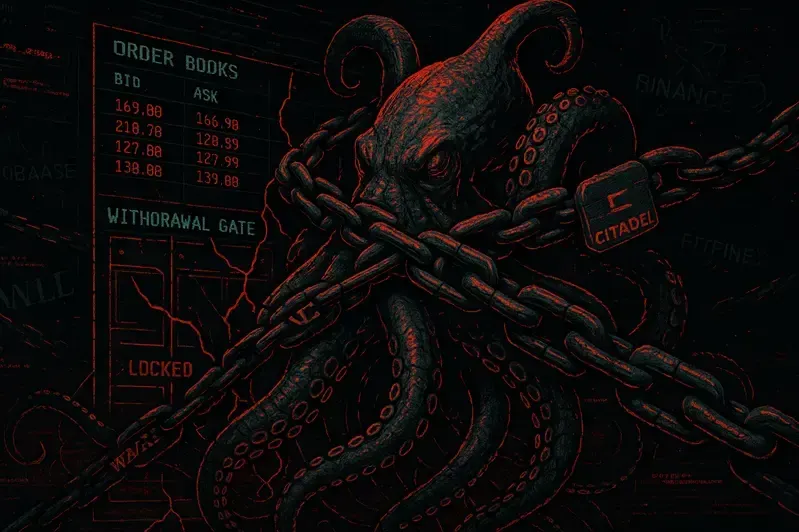
Citadel Securities holds direct exposure to Kraken at $20B valuation. Last major independent CEX captured. Coinbase, Binance, Bitfinex already under TradFi influence. No venue >5% spot volume remains neutral. Terminal signal: immediate migration to non-custodial rails.
// STRUCTURAL SIGNALS (NOV 2025)
- → Kraken completes $800M dual-tranche raise ($600M primary + $200M strategic from Citadel Securities) at $20B post-money valuation.
- → ENS migrates Namechain to Nethermind's Surge (based rollup on Taiko stack); prepares .ens gTLD submission for ICANN 2026 round (testnet expected Q2 2026).
- → Tether executes strategic investment into Ledn (BTC-collateralized lending; amount undisclosed).
- → Ethereum Account Abstraction team publishes Ethereum Interop Layer (EIL) specification for trust-minimized cross-L2 interop.
- → SafePal integrates Hyperliquid perpetuals engine natively (wallet-level perp trading hub).
Among these vectors, only one constitutes a Tier-1 infrastructure capture event: Citadel Securities now holds direct economic exposure to Kraken order flow and custody rails. The remaining signals are secondary or tertiary.
// POWER MAPPING (AS OF JAN 2026)
Kraken was the last large centralized exchange maintaining operational distance from prime-broker capture. Previous vectors: → Coinbase → Goldman Sachs / BlackRock equity + custody integration → Binance → DOJ settlement + surveillance stack → Bitfinex → Tether reserve opacity
Citadel Securities’ entry eliminates the final independent CEX liquidity venue with material spot market share outside TradFi ownership. Citadel’s existing payment-for-order-flow architecture, high-frequency market-making stack, and regulatory capital treatment now extend into Kraken’s matching engine and withdrawal rails. This creates a new control point: any actor routing significant volume through a centralized venue is now downstream of the same entities that dominate NASDAQ and NYSE dark pools. Update Jan 2026: No major new TradFi equity captures in top CEXs since Nov 2025; institutional convergence continues via ETFs/RWAs, but core spot venues remain consolidated under prior influences.
// STRATEGIC MECHANICS
Citadel does not require board seats or operational veto rights to exert influence. Economic alignment suffices. → Liquidity provisioning agreements will route preferential order flow → Risk-parameter synchronization across Citadel desks and Kraken engines → Shared KYC/AML intelligence pipelines (already observable in prior Coinbase integrations) → Collateral haircuts and withdrawal gating calibrated to systemic risk models owned by the same entity
The outcome is structural: large operators can no longer treat any CEX as neutral infrastructure. Every venue is now a potential choke point under unified control.
// OPERATOR INTELLIGENCE
- → Immediate migration of resting liquidity and open orders off all custodial venues with direct or indirect Citadel exposure (Kraken now joins the list).
- → Acceleration of non-custodial routing stacks: THC, Portal-to-Bitcoin, Monero-to-EVM atomic paths, Railgun/Shade private balances.
- → Re-assessment of BTC-collateralized lending exposure: Ledn positions become indirect Tether risk (circular reserve reinforcement).
- → ENSv2 and EIL are containment maneuvers inside the Ethersphere perimeter – irrelevant for sovereign architects operating outside L2 settlement.
- → Hyperliquid integration into SafePal is a wallet-level dependency injection; operators using hardware-signing paths remain unaffected if message signing stays isolated.
Core implication: the centralized exchange layer has reached terminal capture. Future liquidity aggregation must be built on verifiable non-custodial rails or accepted as adversarial infrastructure.
// TRANSMISSION ANALYSIS (JAN 2026 UPDATE)
The Kraken-Citadel transaction completes the consolidation phase of centralized trading infrastructure predicted in prior CACHE256 analyses [→ CEX Capture Matrix 2023-2025]. No remaining venue with >5% global spot volume operates outside TradFi equity or debt influence (Binance still dominant, followed by Bybit/OKX/Coinbase/Kraken). This removes the last veneer of neutrality from price discovery mechanisms that most market participants still reference.
For protocol architects and strategic allocators, the signal is unambiguous: centralized order books are now extension terminals of the same entities that control legacy market microstructure. Design accordingly.
// CACHE256 · Strategic Intelligence · Not Financial Advice · You Are Sovereign