AI Sovereignty Wars: How Tech Giants Are Capturing Decentralized Compute Networks
Traditional AI giants aren't competing with decentralized networks—they're absorbing them. Analysis of how OpenAI, Google, and Anthropic capture distributed compute through enterprise APIs, talent extraction, and hidden infrastructure dependencies.

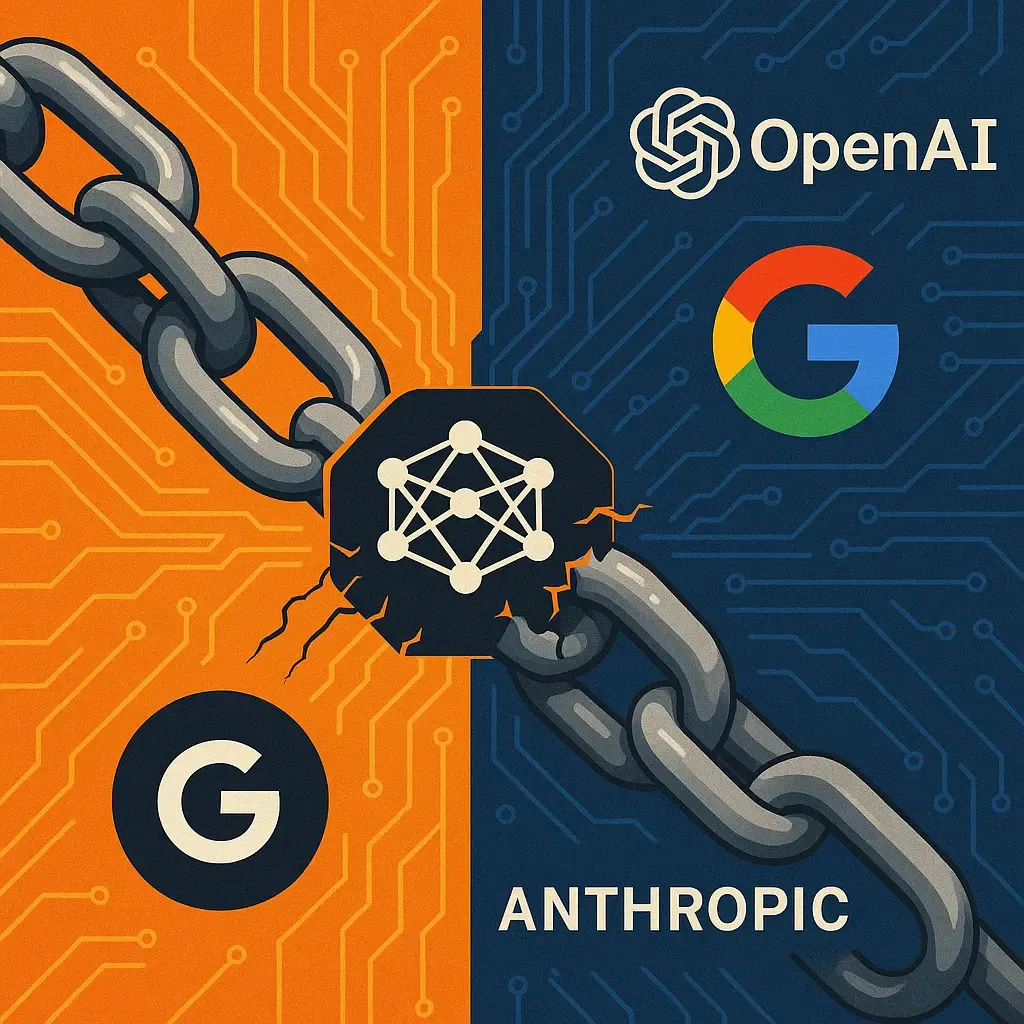
AI sovereignty wars expose the institutional response to decentralized AI disruption: if you can't beat distributed computing, absorb its functionality through centralized enterprise integrations. Rather than competing with protocols like Bittensor and Gensyn, tech giants are building hyperscaler capture networks that deliver decentralized AI benefits while maintaining traditional control mechanisms.
This represents a sophisticated absorption strategy where enterprise API integrations and talent extraction operations provide distributed compute functionality without the inconvenient decentralization that threatens existing power structures. The result: decentralized AI networks become supplementary compute sources serving centralized AI infrastructure.
As OpenAI's valuation surges to approximately $500 billion driven by deep enterprise API integrations [1], the strategic reality becomes clear: hyperscalers aren't fighting decentralized networks—they're capturing them through infrastructure dependencies and regulatory frameworks.
// THE CAPTURE ARCHITECTURE: ENTERPRISE INTEGRATION VECTORS
Layer 1: OpenAI's Corporate Moat Strategy
Through Microsoft Azure partnership, OpenAI's APIs embed in enterprise workflows, rendering decentralized alternatives less viable for large-scale deployments. Corporate integration creates dependency layers that capture value regardless of underlying compute source.
Layer 2: Anthropic's Constitutional Framework
Google's cumulative $3+ billion investment in Anthropic positions "Constitutional AI" for regulated industries where decentralized networks fall short on built-in safety and enterprise support. Regulatory compliance becomes a competitive moat against permissionless alternatives.
Layer 3: Google's Infrastructure Dominance
Google controls at hardware and ecosystem levels with TPUs, TensorFlow, and cloud infrastructure. Even decentralized networks rely on Google Cloud Platform, creating hidden infrastructure dependencies that enable value capture through hybrid models.
→ The absorption mechanism:
Offer distributed compute benefits through centralized APIs. Maintain enterprise control and revenue capture while providing decentralized functionality. Train users to accept AI sovereignty—but only through approved enterprise channels.
// ENTERPRISE INTEGRATION: THE INSTITUTIONAL PLAYERS
🟡 GitHub Copilot: Enterprise Developer Capture
Over 20 million all-time users by mid-2025 [2], with 90% of Fortune 100 companies adopting. Enterprise developers trained on OpenAI-powered tools regardless of backend compute source.
🟡 Azure OpenAI Service: Government Integration
Compliant wrappers for sensitive sectors including $800 million in DoD AI contracts awarded to traditional providers in 2025 [3]. Decentralized networks remain excluded from high-security deployments.
🟡 Salesforce Einstein: Backend Processing Lock-in
Leverages OpenAI's GPT models for enterprise CRM processing. Users interact with "AI" through Salesforce interface while OpenAI captures model execution regardless of underlying compute infrastructure.
🟡 Microsoft 365: Native AI Embedding
OpenAI-powered features across productivity suite create enterprise user dependencies. AI functionality delivered through Microsoft infrastructure with centralized control mechanisms built-in.
// DECENTRALIZED AI POSITIONING: THE ALTERNATIVE NETWORKS
Bittensor: Subnet Specialization Strategy
128 active subnets by September 2025 foster specialized AI markets, but token volatility (~50% monthly) and lack of enterprise SLAs hinder adoption. Top validators control 30-40% of network, raising centralization concerns despite distributed architecture.
Gensyn: Verifiable Compute Infrastructure
Zero-knowledge proofs enable trust in distributed training with theoretical 70-72% cost savings versus cloud providers. However, verification overhead (15-25% penalty) and limited enterprise pilots restrict broader adoption.
Render Network: GPU Coordination Model
$2 billion market cap with 80-85% GPU utilization efficiency in 3D rendering provides blueprint for AI compute coordination. Strong adoption in media/entertainment with emerging AI applications, but quality assurance challenges remain for AI workloads.
// TALENT ACQUISITION AS INFRASTRUCTURE CAPTURE
Research Talent Concentration
AI giants offer packages over $10 million for top researchers, creating brain drain from decentralized projects. Reports of protocol developers from Bittensor, Gensyn, and Ocean Protocol migrating to Meta, Google, and Microsoft research divisions. Talent extraction accelerates centralized innovation while weakening decentralized alternatives.
Academic Institution Capture
Stanford HAI distributes $50 million in grants with Google cloud credits up to $100,000. OpenAI's NextGenAI partnership launched March 2025 for $50 million in MIT grants. Academic funding steers research toward centralized compatibility rather than decentralized alternatives.
// HIDDEN INFRASTRUCTURE DEPENDENCIES: THE CONTROL LAYER
Cloud Provider Concentration
Decentralized AI shows centralization via cloud reliance: ~70% of nodes run on AWS (31-32% global market share), ~20-25% on Microsoft Azure, ~10-20% on Google Cloud. Cloudflare handles 50-65% of bandwidth traffic, creating hidden centralization points in "decentralized" networks.
API Standardization Capture
Many decentralized projects adopt OpenAI-compatible APIs for developer familiarity, with 95% enterprise preference for standard APIs. This creates high switching costs and lock-in effects while simplifying integration but ceding architectural control to centralized providers.
// HYPERSCALER COUNTER-POSITIONING: THE COST ARBITRAGE
Hyperscaler Pricing (Q3 2025):
- OpenAI GPT-4o: $2.50/1M input, $10/1M output
- Anthropic Claude Sonnet: $3/1M input, $15/1M output [4]
- Fixed pricing models with enterprise SLAs
- 99.9% uptime guarantees with dedicated support
Decentralized Alternatives:
- Raw compute: $0.003-0.005/1K tokens
- Total Cost of Ownership: 40-60% higher including integration
- Token volatility impacts budget predictability
- No guaranteed uptime or enterprise support
Innovation velocity advantage: Centralized development cycles operate 3-5x faster than consensus-based decentralized alternatives. Hyperscalers control sales teams (500+ at major providers), ecosystems, and marketplace distribution channels.
// WHAT FAILS IN DECENTRALIZED AI: STRUCTURAL LIMITATIONS
Enterprise Adoption Barriers
With 78-99% of Fortune 500 using AI predominantly from traditional providers, decentralized networks face structural issues: impossible SLAs, lack of enterprise support teams, distributed governance hindering regulatory compliance, and budget unpredictability from token volatility.
Economic Model Sustainability
Speculation drives 60-70% of token value in decentralized networks. Bear market contributor churn, quality assurance overhead (15-25%), and capital inefficiency through underutilization create unsustainable economic models for enterprise deployment.
Technical Architecture Limitations
Consensus mechanisms add overhead creating 2-5x slower latency, 20-30% bandwidth overhead, network partition risks, and slow upgrade cycles compared to centralized alternatives. Performance gaps persist despite theoretical cost advantages.
// CACHE256 STRATEGIC INTELLIGENCE
AI sovereignty wars aren't wars. They're absorption operations.
Hyperscalers that couldn't stop decentralized compute are learning to capture it.
Distributed benefits, centralized control. Decentralized infrastructure, enterprise APIs.
The capture is sophisticated.
→ Offer distributed AI functionality through enterprise integrations
→ Train developers to accept decentralized compute—but only through approved APIs
→ Extract talent from decentralized projects through premium compensation
→ Control innovation velocity through regulatory compliance requirements
This isn't hyperscalers adapting to decentralized disruption.
This is decentralized AI being domesticated by enterprise infrastructure.
What appears as competitive dynamics is actually institutional absorption.
They're not joining the revolution.
They're capturing it.
// KEY SOURCES
Primary Sources:
Additional Sources (Domain Citations):
CNBC (OpenAI valuation, AI talent wars, Meta poaching), The Guardian (OpenAI private company valuation), CoinDesk (Bittensor ecosystem), Business Insider (AI talent wars impact), Silicon Republic (Google Anthropic funding), Microsoft Research (Berkeley AI partnerships), CloudZero (AI pricing analysis), Emma.ms (cloud market share), Statista (cloud market trends), Cloudwards (cloud provider comparison), DEV Community (API standards), Demand Sage (AI statistics), Netguru (AI adoption metrics)
// RELATED CACHE256 INTELLIGENCE
AI Infrastructure Analysis
Control Systems Analysis
// FREQUENTLY ASKED QUESTIONS
What are AI sovereignty wars?
AI sovereignty wars refer to the strategic competition between traditional tech giants and decentralized AI networks. Rather than direct competition, hyperscalers like OpenAI, Google, and Anthropic are absorbing decentralized compute functionality through enterprise APIs, talent extraction, and infrastructure dependencies while maintaining centralized control.
How do hyperscalers capture decentralized AI networks?
Hyperscalers use enterprise integration strategies, talent acquisition with $10+ million packages, regulatory compliance advantages, and hidden infrastructure dependencies. Most decentralized networks rely on AWS, Azure, or Google Cloud, creating centralization points that enable value capture through API standardization and hybrid deployment models.
What challenges do decentralized AI networks face?
Decentralized AI networks struggle with enterprise adoption barriers including impossible SLAs, lack of dedicated support, regulatory compliance gaps, token volatility affecting budget predictability, technical limitations like 2-5x slower latency, and economic sustainability with 60-70% of token value driven by speculation rather than utility.
Are decentralized AI networks truly decentralized?
While architecturally distributed, most decentralized AI networks show centralization patterns: ~70% of nodes run on AWS, top validators control 30-40% of networks like Bittensor, Cloudflare handles 50-65% of bandwidth traffic, and many adopt OpenAI-compatible APIs. This creates hidden infrastructure dependencies that enable traditional providers to capture value.
What's the future of decentralized AI compute?
Decentralized AI networks are likely to serve as supplementary compute sources for traditional AI infrastructure rather than independent competitors. Hybrid models provide cost arbitrage opportunities while hyperscalers maintain control through enterprise integrations, regulatory compliance, and infrastructure dependencies. The result is "decentralized" functionality delivered through centralized channels.