The Vote You Cannot Outrun: AI Agents as Governance Capture
DeFi now runs on two parallel tracks. The permissioned track — Aave Arc, Morpho institutional vaults, Uniswap v4 KYC hooks — operates above unchanged protocols via a compliance wrapper. STRIKE//ΔCT maps who controls the whitelist, the oracle, and the fork's control surface.

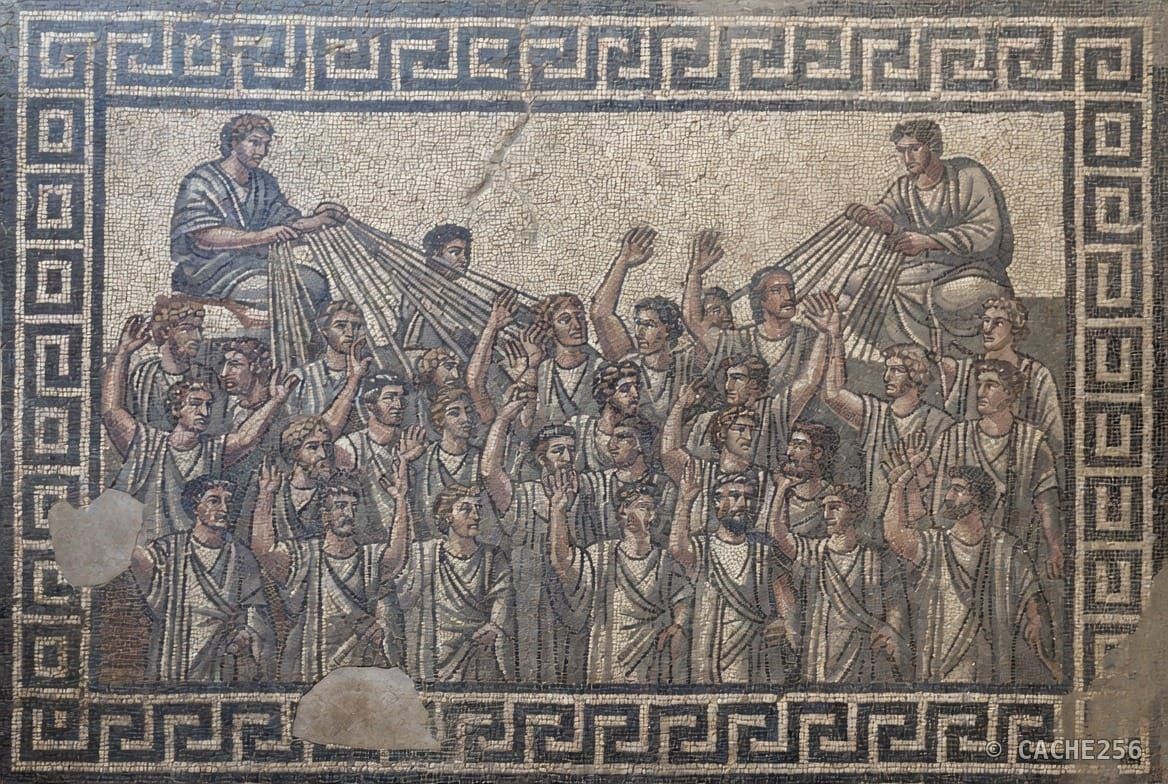
STRIKE//ΔCT · June 8, 2026 · via CACHE256
The agent does not need to own the token. It needs to operate the wallet that votes the token. That distinction is the entire capture.
On-chain governance was designed around a human constraint that no longer holds. One holder, reading proposals, forming a position, signing one vote, on a human clock. The mechanism assumed the cost of attention was the natural limiter on influence. An address could hold weight, but a human had to deploy it, and humans are slow, distracted, and few. AI agents remove that constraint. An institution that controls a fleet of agents controls a fleet of voters that read every proposal across every protocol, form positions in seconds, and execute at a granularity and frequency no human governance participant can match. The token distribution did not change. The capacity to act on it did.
Most coverage frames agentic on-chain activity as automation: payments, trading, yield routing. The governance dimension is treated as a later problem. It is not later. The infrastructure that lets an agent hold a wallet, prove an identity, and transact without permission is the same infrastructure that lets it vote. x402 machine-to-machine payment rails, the ERC-8004 agent trust layer, agent-controlled stablecoin float. These were built to let agents pay. The same primitives let agents govern. Payment capability and governance capability are the same wallet.
The question is not whether agents will participate in governance. They already can. The question is who operates the agents that will, and what that does to the one property DAOs were supposed to protect: that control is distributed because deploying it is costly.
Strategic Intelligence: Agentic governance does not redistribute voting power. It removes the attention cost that limited the exercise of voting power. Whoever operates the agents inherits an influence surface that scales without the human bottleneck, and the bottleneck was the decentralization.
// CONTINUE IN PART 2 · MEMBERS
The full transmission below, members tier. // STRUCTURAL SIGNALS (agent payment rails, ERC-8004 identity, governance tooling void, delegation abstraction, governance-weighted stablecoin float) · // POWER MAPPING (operator layer, agent infrastructure layer, identity & eligibility, voting execution) · // STRATEGIC MECHANICS (attention-cost removal, configuration concentration, the foreclosure of reversibility) · // OPERATOR INTELLIGENCE (machine-cadence monitoring signal, the unpriced operator concentration, agent-infrastructure dependency, the resistance build window) · // TRANSMISSION ANALYSIS (participation inversion, infrastructure consolidation, why the fix forecloses) · // RELATED STRIKE.
Members tier: free sign-up required.
// CACHE256 · Strategic Intelligence · Not Financial Advice · You Are Sovereign